Saturday, February 25, 2017

Trips to New York always feed my optimism.

On this trip, I decided, as I often do, to joyride the subway out to my home borough of Queens. In particular, I boarded the 7 train at its new extension, the Hudson Yards station (11th Ave. and 34th Street, the new northern endpoint of the High Line). The Hudson Yards redevelopment encompasses some of the most rapid and frenetic construction I've seen in Manhattan, but that’s another thread for another time. I stayed on the 7 train all the way til the last stop, Main Street/Flushing. The 7 train is aboveground from the moment it emerges from the Steinway Tunnel into Queens, snaking its way through Long Island City and settling into a long graceful run along the Queens Boulevard viaduct, one of the classiest structures in the entire subway system. The route runs over Roosevelt Avenue through Jackson Heights, where I grew up, and Elmhurst, which still holds the record for largest number of languages spoken within one Zip code (11373). It then glides over Flushing Meadow Park, past the CitiField stadium (which replaced the venerable Shea Stadium) and the Unisphere, and then dives underground, almost as if it were frightened, at the very last possible moment before entering Main St./Flushing station.
I hadn't been to that neighborhood since childhood; the RKO Keith theater, where I'm pretty sure I first saw Star Wars, wasn't far from there, nor was the YMCA where I have a vague memory of going to swim classes.
Today, though, I stepped out of the station and into Little Taiwan/Little Korea. The Main St. station area rivals Jackson Heights’ 37th Avenue for density, but everything was Asian: open-air markets and stalls, grocery stores and restaurants and clubs with names displayed only in Asian scripts, a bewildering variety of vegetable and animal products on sale in bins on the sidewalk. It was happy chaos.
It was fun to walk around there, but practicality soon demanded my attention, as I needed to pee. A block away was the Flushing branch of the Queens Borough Public Library, a system I had patronized heavily as a child. I was sure I'd be welcome to use the restrooms there.
And so I was; but not before noticing that the library was packed. Every computer terminal on four floors was in use. Every reading table was filled with readers. The variety of languages represented in the fiction shelves—Russian, Polish, Armenian, Korean, Turkmen—was astonishing, as was the fact that every aisle seemed to have people browsing. There was a rack of literature in multiple languages on how to become a US citizen. There was a desk staffed by WorkForceOne—a NYC-staffed publicly funded employment agency that runs job fairs, provides connections to job training and placement, and so on, all at public expense. People were using the library as the civic resource it was meant to be. Why can’t the San Francisco Public Library serve its constituency so richly?
On my way back on the 7 train, I gravitated to the front car so I could look out the front window as we barreled down the tracks. (The 7 train is one of the few that still affords that pleasure.) I eavesdropped on a conversation between two high-school-age African-American boys until I realized that the video games they were discussing were simulators that let you pretend you are driving a train. They were discussing the impending release of the simulation files for the Chicago Transit Authority (“the El”). One of them had a phone app that included schematic drawings of all the NYC subway cars ever built, and he was trying to identify the car in which we were riding. If you ever wondered what a middle-aged white man and two African-American high school students could bond over, now you know.
To top off the day: I finished the afternoon by walking around my old neighborhood of Rego Park. Purely by coincidence, as I was walking past my old home (62-23 Cromwell Crescent), a middle-aged lady emerged. I realized I was staring, and as if to excuse myself, I addressed her: “I’m sorry, I don’t mean to alarm you. But 35-plus years ago, I grew up in this house.” She was very kind and said she remembered the person her son had bought the house from—my father. She even invited me into the house to look around. The kitchen cabinetry was unchanged from when I was 17. The dining room had the same fabric wallpaper my dad had had installed sometime during my high school years. I was moved, to say the least. She assured me that if I should return to the neighborhood with my wife or children [sic], we would all be welcome in her home. On the way back to the subway, I stopped at the fruit stand that has been there since I was a child. It’s still in business, and I bought a bottle of seltzer water whose label I couldn’t even recognize the writing on. (Close inspection of the label revealed that the writing was Armenian script.) On my way back to my friend’s house in Harlem, I stopped at a food truck. The vendor was a Middle Eastern man who barely spoke English; he was selling food to an African man who barely spoke English. I ordered onion rings and a gyro.
I don’t believe the universe sends us messages. I suppose if I believed that, today would be an indication that the universe was trying to send me a positive message. But I think it’s a lot simpler than that. People of many stripes, just trying to make their own way—that is the universe’s message. There aren’t many places where the message is as loud and clear as it is in New York, which is one of the many reasons I love visiting here. It should be a required visit for everyone.

Sunday, January 08, 2017

Day 1 & 2 - Delhi

Hi everyone,

Sorry about the protracted silence...

Tonia and I arrived safely in Delhi after a whopping 16.5 hour direct flight from SFO—fortunately in business class, so we got some sleep and arrived in fairly good shape. The flight path took us easterly over the North Pole, crossing over Norway, Finland, Russia, the 'Stans, and then entering Indian airspace over Amritsar. Getting through Delhi's modern airport was a breeze and quicker than expected.
From the moment we touched down here we've been among family. My undergraduate student Nikunj from Berkeley met us at the airport and drove us to his grandfather's house, where he's been spending some time during winter break.
I should explain that Indian families tend to live together—two or three generations in a single house, or sometimes in adjacent or nearby ones—so Indian homes are large, with 6 bedrooms not uncommon. Nikunj's parents are separated and his dad lives in Chennai, but when he comes home he also spends time at the home where is grandfather, uncle, and nephew/niece live, and he had invited us to stay there, in a luxurious guest bedroom. The evening of our arrival we had a splendid home-cooked Indian dinner. Nikunj and his family are followers of the Jain religion, whose distinguishing precept is "harm no living thing"; strict Jains do not even eat root vegetables, though milk is OK if it's from a happy cow. Confusingly, eggs are not OK, despite the fact that unfertilized eggs don't represent any loss of life. At any rate, everything we've eaten in the country so far (I write this 72 hours in) has been vegetarian, which is just fine.
We had a great conversation with his illustrious grandfather, Vijay Kumar ("VK") Jain, who has a remarkable life story: he came out of poverty with nothing, doing menial work and day labor to work his way up, and determined to learn to grow his own food so that he'd never starve. He ultimately became a successful charter accountant (think CPA) and is now retired and quite well-to-do, but never forgot the value of work and passed it on to his family. He's widely traveled, speaks great English, and can hold forth on a variety of topics—a very interesting guy to be with.

[photos coming soon]

After a great night of Benadryl-induced sleep to try to adjust to local time, the next day we had the morning available since our flight to Jodhpur wasn't until 1:30pm, so Nikunj and his grandfather took us for a walk in Lodi Gardens, a lovely public park adjacent to the residences of federal government mucky-mucks (Delhi is the capital, after all), and we ran into the Attorney General for India, who (along with many other government higher-ups) is apparently a good buddy of VK.
The Lodi Gardens, like many public parks in Rajasthan (as we would soon learn), included temples and ruins dating back hundreds of years; and on this smoggy Saturday morning people were out walking, doing yoga (yes!), and so on. (Not walking dogs; most dogs we saw were strays.) When I say "smoggy", the air quality index was about 175 ("unhealthy") and the visibility less than 1/4 mile—like Beijing on a pretty bad day. People take it in stride, but it does make you appreciate the air quality of most US cities, something we usually take for granted.
As you may know, in November the Indian government invalidated 500- and 1000-rupee notes—nominally to clamp down on fraud and black market activities, though surely any sophisticated black marketeer wouldn't just keep a shoebox full of notes under the bed, so this move mostly hurt middle-class people. (Only 4% of Indians pay income tax; over 87% of wage transactions in the country's economy are off-the-books; under-invoicing and over-receipting are so widespread as to be universal.) The result is that no US foreign exchanges have rupees at all (most of them wrote off their entire inventory of rupees as a loss), ATMs in India have hour-long queues and run out of cash early in the day, and many ATMs don't even work because the new 1000- and 2000-rupee notes are a different size than the old ones so the machines must be modified. In all, the "demonetization" has been a major bungle, and although major tourist destinations accept credit cards, day-to-day business in India is overwhelmingly a cash economy, and people are pissed. Anyway, VK was kind enough to loan us enough cash to get us through any trip expenses that weren't prepaid and for which we couldn't use credit cards—the idea was I'd repay Nikunj in US dollars back in Berkeley, since he needed spending money and it was easier to do this than to have US dollars obtained in India.
We made our flight to Jodhpur relatively easily.  That's where we are now, and that'll be the subject of the next post.  We'll add some photos here too, or on Facebook under Tonia's account.

Tuesday, June 28, 2016

Baltics 2016 - wrap-up


"Have you been to the Baltics?" Yes. Yes, we have.

We have been to Helsinki:
  • Sauna including jumping in the Baltic
  • Best rooftop bar (Skyview at Hotel Torni)
We have been to Tallinn:
  • Europe's oldest continuously operating pharmacy (1422)
  • The III Dragons pub, an authentic cellar in the Town Hall featuring beer and hand pies served by surly women in medieval garb...
  • ...which is also where we met Yvgenia, a seed biologist from the University of Latvia attending a conference there, who recommended that we visit the pub "Ala" when in Riga
  • Neighborhood locals bar featuring accordionist, danseuse/chanteuse, and sad drunk lady
  • Drinking Vana Tallinn and shots of Milli-millika, a vile concoction of tequila, Jaegermeister, and Tabasco sauce
  • Post-tour lunch and travel-tips exchange with visitors from Korea, Mexico, Colombia (living in the UK), at a restaurant where we had herring and crepe-like pancakes filled with salmon
  • The movingly-presented Museum of the (Soviet) Occupation
  • Climbing to the top of the steeple of St. John's church, with its vertigo-inducing 1m-wide observation ledge
We have been to Riga:
  • Buying smoked pork and homemade black bread in the enormous (4 Zeppelin hangars) locals market 
  • Experiencing two nights in a row of trying over 20 Latvian beers (mmm) with local cuisine while listening to Latvian folk music in Ala, a beer cellar dating back to the 13th c.
  • Taking the commuter train out to Kemeri National Park and renting bikes for a 20 mile ride through the bogs and forests
We have been to Vilnius:
  • Lunch with our tour guide and various visitors, during which we had the US, UK, Finland, Argentina, Germany, Croatia
  • A visit to the oldest university in the Baltics, including climbing its belfry, whose interior construction looks like it might give way at any moment
  • Staying in a former Carmelite monastery, Domus Maria
  • Dinner with Vita Reinys, who may or may not be related to Tonia, in a traditional and earnest Lithuanian restaurant where every aspect of the meal was carefully explained, we sampled different kinds of honey mead (traditional aperitif/digestif distilled from honey), and the host did a shot with us as we closed down the restaurant
  • A brief visit to the Lithuanian Railway Museum (located at the train station) followed by what is surely the world's shortest ride between downtown and an airport: 5 km, 5 minutes, 1 stop
And we have experienced the Baltic culture's major holiday, Jonines (St. John's Day) aka the midsummer/solstice festival, at its major nature destination, the Curonian Spit (a UNESCO World Heritage Site):
  • 30-mile bike ride along the spit, including a traditional Lithuanian lunch, a walk on the dunes, and a dip in the Baltic
  • Buying local smoked fish for dinner and washing it down with more honey mead
  • Watching the traditional ceremony in which young single women float their wreaths in the harbor; a wreath that floats away quickly means she'll be married soon
  • Hanging out with the traditional musicians during the after-party
…and we did it all accompanied by Travel Penguin.

Baltics—check!

Sunday, June 26, 2016

Baltics 2016 part 5 - Curonian Spit and Jonines

Curonian Spit cottage and waterfront walk

Bike tour

Nature trail, dunes, sundial

Jonines

Jonines afterparty

Trakai and homeward bound

Next: Baltics wrap-up

Baltics 2016 part 4 - Vilnius

We arrived in Vilnius as it was getting dark, around 9pm, and as usual we were able to walk to our accommodations. This was our one non-AirBnB stay, in a hotel called Domus Maria, formerly a Carmelite monastery; the monk's rooms have been converted to guest rooms.
The view from our room at Domus Maria. Just behind this church is the "Gate of Dawn" which is one of the original gates of Old Vilnius.

Just in time for an outdoor snack at a tourist-facing watering hole in old town.

As in all the Baltic capitals, we enjoyed a great free (donation-only) walking tour led by Milda, another young Balt with great English and a friendly affect.

One of the tour highlights was Uzupis, a sort of bohemian enclave within Vilnius that has declared itself a separate state with its own whimsical Constitution. It's a cute tangle of weird art, coffeeshops, and galleries, whose "laws" include things like mandatory smiling. It's earnest and innocent, the way I imagine bohemian enclaves in US cities might have been before the seventies—earnestly funky without the gritty. (At least no gritty that we saw.)

Even Vilnius's former mayor got into the spirit of things—in 2012, as part of his tough stance against illegally-parked cars blocking bicycle lanes, he rolled over an illegal parked vehicle with a tank.


After the tour we joined our tour guide for a very international lunch—our tour group encompassed the USA, Germany, Croatia, Finland, Argentina, plus of course our Lithuanian tour guide. We had a great traditional lunch and swapped travel stories.

I wanted to make sure to see the University of Vilnius, which, though small, is architecturally interesting because of the range of styles spanned by its courtyard-oriented footprint. I did manage to acquire a T-shirt from its bookstore, and we checked out the very creepy murals in the Humanities buildings. ("Joy is but the shadow pain casts.")


We also managed to climb to the top of its belfry, whose interior construction looks like it was done by children with Tinkertoys, but does afford a nice panorama of Vilnius.

The "new town" is visible beyond, but we didn't really have time to explore that part.


That evening we met up with Vita Reinys at Senoji Trobele, a very traditional Lithuanian restaurant. You know it's traditional because every dish is painstakingly explained—they're clearly very into what they do. And it really was a great meal.
No one knows if Vita is related to Tonia's family or not; they know no common relatives, but the name is sufficiently uncommon that it seems they must share one if you go back far enough. Vita actually grew up in Chicago in a Lithuanian neighborhood (so grew up speaking the language), and after several years of being burned out from nursing, she decided to reboot her life and thought hey, why not move to Lithuania? So here she is, and several years later she has been adjusting well, but it was amusing the first time we met her to hear straight-ahead American English with a Chicago twang.


Vita and Penguin enjoying honey mead, a traditional Lithuanian spirit, here served in shot glasses made of ice.
At the end of the evening, the restaurant owner treated us to a final shot of '999', a Lithuanian digestive made with 27 herbs (hence the name). We ended up bringing home a bottle.

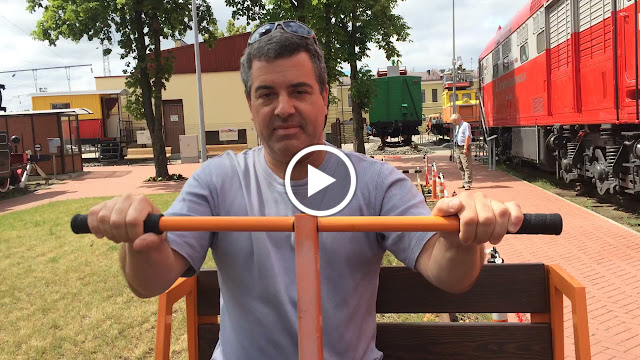
The next day our plan was to spend a half-day in Vilnius, then pick up our rental car at the airport and do a leisurely drive to our next and final destination, the town of Nida on the Curonian Spit. Our car pickup was at the airport, and since the timing of trains to the airport was such that we had 45 minutes to spare, we visited the small but interesting Lithuanian Railway Museum, which uses some maintenance tracks alongside the Vilnius train station. We saw vintage (including Soviet-era) Lithuanian Railways rolling stock and locomotives, and even got to hand-operate one of those track-inspection carts you see in cartoons all the time!


It looked to be about a 4.5 hour drive

Railway museum

The world's shortest airport train

The boring drive to the Curonian Spit

Next: the Curonian Spit and Joninés

Baltics 2016 part 3 - Riga

We had learned from our fellow-travelers in Tallinn that the only train service in the Baltics is local suburban trains from the capitals; international travel between the capitals is by bus. (The one exception is St. Petersburg, to which you can travel by train from Tallinn.)

The buses were all express, joining the Baltic capitals with no intervening stops. This surprised me since, without a rail network, I wondered how people get to the smaller towns and other things between the capitals. (We would later learn that in general, there are no smaller towns or other things between the capitals.)

Miguel Ángel and Roberto had been traveling northward from Lithuania by bus, and assured us that the buses were really comfortable, with free wifi, free coffee, and so on–they made it sound like business-class air travel, and we did spend a little more to book with the company that is supposed to have the more "deluxe" and comfortable coaches.

We were quickly reminded, though, that (a) even the most comfortable bus in the world is still a bus, and (b) these weren't the most comfortable buses in the world. They weren't terrible, but the seats weren't particularly comfy and the wifi never worked. Oh well. They run pretty much on schedule, and we arrived in Riga around dinnertime and checked into our AirBnB hosted by Ed, a very cool hipster type guy and located smack in the middle of Old Riga.
Rihard Wagner gatve, our street in Riga

View into courtyard from our studio apartment
In Tallinn we had shared a table with a reserved young woman who turned out to be a professor visiting from the University of Latvia—she was in Tallinn for a seed biology conference—and we had asked her for recommendations on where to eat in Tallinn. She recommended Ala ("Cave"), a beer cellar dating from the 13th century that is now known for its wide variety of Latvian beers on tap, traditional cuisine, and traditional folk entertainment. The Baltic capitals are small and we always stayed in the old town, so Ala was just a few minutes' walk from our apartment.

Ala turned out to be a highlight of the trip. It was packed mostly with young people, listening to Latvian folk music played by a traditional-instruments ensemble! And the Latvian beers were simply amazing—we had sampler after sampler and must have tried 20 beers in all during our two visits to Ala. The entrées were inexpensive, and the unfortunately named "Grey Peas" was delicious, peas in a smoky gravy served in a hollowed-out dark bread loaf.
Ala interior. The back portion, where the band plays, dates to the 13th c.

The first of 4 samplers

Folk music!

Mmm, grey peas. Tastes much better than it sounds.

The next day we found the Free Walking Tour of Riga, which again was excellent, and led by a guide who looked kind of like David Lehr. The market stalls are four zeppelin hangars that were abandoned by the Germans after WWI, dismantled brick by brick by the Latvians, and reassembled here…

Inside one of the market buildings

Buying smoked pork (a/k/a ham), a Latvian specialty
The tour took us to the "Moscow Quarter" of Riga, where many Russian immigrants lived. The houses there had been made of wood, so that if an enemy approached, the neighborhood could be set ablaze as a deterrent to the enemy entering the city. The story has it that a slightly drunken resident mistakenly raised the alarm in 1812 thinking Napoleon's army was approaching (it wasn't), so the district was proactively burned to the ground for no reason, though a very few of the traditional wood buildings still stand.
Traditional wood-construction building in the "Moscow quarter". The tower in the background is "Stalin's birthday cake"—see below.


Our David Lehr doppelganger tour guide standing in front of the building built to commemorate Stalin's 80th birthday. Apparently other eastern European cities including Warsaw have similar monstrosities. It was to serve as worker's housing of some kind.


Kemeri National Park

For our second day in Latvia, we decided to go out to Kemeri National Park, a forest-and-bog preserve on the coast and about 40 minutes away by commuter train (fare: about 80 cents each way). 
Bike rental was available at the train station…

…but other than the bike rental guy, there's really no one out here.


Lovely wetlands mix with new-growth forest

A couple of nice birdwatching decks overlook the wetlands
We turned in a solid 20 to 25 mile loop ride on roads, fire roads, and mild single-track. Most of the second half of the loop just followed the coastal road, so we took the opportunity to check out the beach, which was quite attractive but not very busy—this part of the country isn't the "beach destination".  That distinction belongs to Jurmala, the "Latvian Riviera", which the train actually passes through on the way to Kemeri. It's the same stretch of beach, but there is a town with Swiss/European pretentions, which reminded me a little of Montreux, Switzerland. Apparently this is where wealthy Russians would vacation and/or build big beach mansions. We skipped it, though plenty of families were getting on and off the train there.
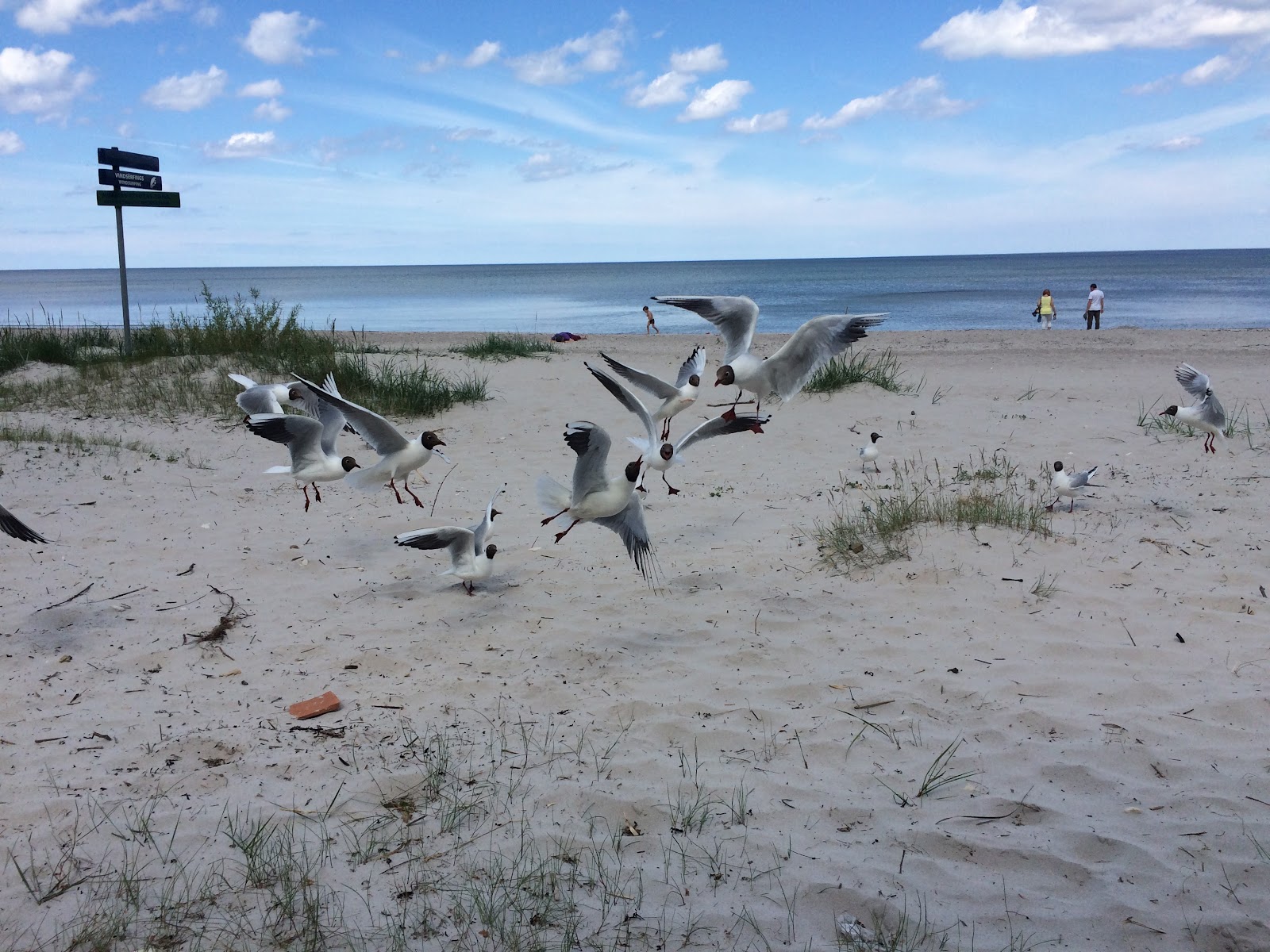
The gulls got the fatty parts of our smoked pork. This beach is a few miles west of Jurmala.

Awful-smelling sulfurated carbonated water emanates from this natural spring adorned by a lizard head. Tonia drank a bunch; I found it retch-inducing.


On the bus to Vilnius, we finally tried Black Balsam, the traditional Latvian digestive. Interesting taste, but it didn't make the threshold for bringing home a bottle.

Lithuania as seen from a bus. There really isn't anything urbanized in between the major cities.


Next: Vilnius


Baltics 2016 part 2 - Tallinn

The Old Town of Tallinn (that's pronounced TAHL-linn) dates from medieval times, and it's been lovingly restored, Disneyland-like, to look just like that, to the point that many businesses' employees dress in period garb. Surprisingly, the effect is pleasant rather than cheesy. Being medieval is Tallinn's brand. We stayed in a renovated studio—the building was 600 years old but the recently-remodeled apartment had a small personal sauna in the bathroom! AirBnB FTW.
Looking down from the High City into the Low City
One of the main streets of Old Tallinn


Outside the medieval walls

Despite some rain, our free walking tour was terrific. (We enjoyed free donate-what-you-like walking tours in all three Baltic capitals.) There are spectacular views of the "lower city" (where the working folks lived and where the taverns were) from the "upper city" just outside the walls (where the nobles lived). Much of the city wall is either intact or reconstructed, with the original city gates. The sense of being in a medieval walled city is authentic.


With our tour guide Heli. All young Estonians speak great English—which they apparently learn from American and British TV and movies!

One of the city gates…


After the tour we had lunch with some of the other tour-goers, including Roberto (Colombia), Miguel Ángel (Mexico, but currently living in UK), Soh (South Korea, at right), and ???. A great tip we got from Roberto and Miguel Ángel, who had been working their way north from Poland, was to go to a bar called Ala in Riga…more on that later. We were particularly impressed by Soh, who seemed late 20something or early 30something and had traveled solo on the Trans-Siberian Railroad over a 3-week period as part of spending several weeks traveling.


In the evening, we went to a bar just outside the city wall that Lonely Planet had identified as a locals bar. True to form, no one there including the bartender spoke English; it attracted an older crowd (the bars within the walls attract a younger and more touristy crowd); and two of the customers had appointed themselves the concertina player and chanteuse/danseuse. It doesn't get more authentic, as the short video clip suggests.

  The guy next to me taught me to say a quo vadis in Estonian, which I've since forgotten, and when I asked him for advice on trying a "local specialty", he suggested Milli-millikas. This turns out to be a vile concoction of cheap tequila, Jaegermeister, and quite a bit of Tabasco sauce, consumed as a shot. Don't try it. But the bartender also suggested trying Vana Tallinn ("old Tallinn"), an herbal digestive liqueur made in Tallinn.  That we liked a lot, and ultimately brought home a bottle.


The next day took us to the very moving Museum of the Occupation. The Baltics have actually been occupied at one time or another by Sweden, Poland, Germany, Russia, Germany again, and the USSR, before gaining their independence in 1991 after the dissolution of the USSR. As the museum points out, unlike the Jewish Holocaust, whose story was amply documented immediately after the Allies liberated Europe, the Baltic citizens who were deported to Siberia during the Soviet occupation were later forbidden under penalty of death from writing about their experiences or even discussing them with others, so the details of the Baltic tragedy are far less known to outsiders. But their occupation was no less horrible, and the atrocities visited on them by the Soviets no less heinous than those visited by the Nazis upon the Jews, if perhaps not at the same scale. During the post-WWII occupation, the Baltic countries lost fully a third of their population via deportation and execution.

Given we had had only had a day and a half in Tallinn, we decided to modify our original plan. Instead of spending a day in the university town of Tartu and visiting Sigulda Castle, we decided to focus on the Baltic capitals. A bit of investigation quickly revealed that the trains here don't go anywhere useful—local service only, for the most part—and that buses are the way to get around. So we booked a bus ticket for the following afternoon to Riga, the Latvian capital, about four hours' drive away.

Next: Riga