Thursday, July 05, 2018

Two days in Cyprus

Cyprus is a big beach destination for much of eastern Europe, the near Middle East (especially Israel and Lebanon), and Russia: it's nearby, inexpensive, and sun-baked. The landscape looks a bit like northern New Mexico—hot and scrubby—as you can see in these photos of the University of Central Lancashire's Cyprus campus (red & white building, where the conference was held) and the new student housing (white building at right—it's a panorama shot so the road is not really curved). The latter are so new that the road leading to them isn't even paved yet; it looks for all the world like an American condo subdivision going up.

(I'm still not sure why UCLan opened this campus. I suspect the answer is either to make money, or as a loss-leader to feed students to their main UK campus, as this school is not particularly a top tier school. I get the sense many Cypriots like their kids to study a lot of English to make sure they have opportunities after school, and the ones who can afford it send their kids to spend some time studying abroad; the UCLan's brochure "The British University in Cyprus" seems to capitalize on this.)

After the first conference day some of us went downtown for dinner, as there is literally no food to be had on campus after hours (other than pizza delivery to the dorm—really). Larnaca's downtown waterfront reminds me a little of the French Riviera, though I don't mean that in an entirely complimentary way. There's the usual assortment of nondescript but pleasant outdoor cafés; a beach that isn't very wide or very sandy, quite packed with beach umbrellas in neat rows; and enough people bathing that suggests the water's reasonable, but not so many as to make bathing festive.

Seems like a nice enough beach, but having just come off a week in Cozumel last month, I wasn't strongly regretting not bringing a swimsuit.
The most interesting part of the evening, though, was what I learned from the bus driver's narration on the way to town (which is a good 25-30 minutes from campus). Disclaimer: You probably know all this. I felt woefully ignorant that I did not.

Historically Cyprus has been a mix of Turkish and Greek culture. In 1974 the Turkish army invaded/occupied the northern part of the island and set up a "country" there that is recognized by no one except Turkey. They expelled most of the ethnic Greeks and took their homes, sending a wave of refugees to the southern part of the island. The island is now ethnically basically segregated, and the Turks are said to be stamping out all signs of Greek culture and heritage in the occupied portion. This explains the UN "Green zone" mentioned in my earlier post: the campus is within the "buffer zone" between Cyprus and the Turkish-occupied zone, presumably so that in case of trouble the campus would remain open and accessible (or at least, the British could get in there and evacuate it).

You might wonder why nothing has happened to end the occupation given that Cyprus was admitted to the EU in 2004, and occupation by a foreign power is a violation of the EU constitution. (Of course, the country doing the occupying isn't an EU country, and indeed the occupation is a main obstacle to Turkey being allowed to join.) The EU has fined Turkey $100M (which it hasn't paid), ordered it to leave Cyprus (it hasn't), censured it (Ankara has conspicuously ignored the censure), and ordered Turkey to stop destroying Greek culture in north Cyprus (they continue to do so). If you believe my cab driver, and I'm not saying you should, the EU has also cajoled Cyprus into solving the problem diplomatically rather than, say, cutting the power lines and infrastructure into northern Cyprus. The Cypriots are understandably skeptical that diplomacy will work now if it hasn't worked since 1974, and they mutter about the Turkish genocide in Armenia (there is apparently a significant Armenian community in Cyprus that was seeded by the refugee exodus when Turkey invaded Armenia early in the 20th century). But to hear the history of the country, it's been occupied, ruled, or overrun by foreign powers so many times—the Phoenicians, the Greeks, Alexander the Great, the Ottoman Empire, the British Empire—that maybe people are resigned to this being a fact of life. I don't know. At any rate, it meant that when I had some beers with Turkish-speaking guys (previous post), it was pretty rare to hear Turkish spoken in the south part of the island, and most people don't take kindly when they do hear it, kind of like speaking Russian in the Baltic countries. To most people you'd speak to in south Cyprus, the culture is basically Greek culture. This also explains why Google Maps shows place names in Greek and Turkish on different parts of the island.

The following afternoon we got a "walking tour" of downtown; we saw the Byzantine Church of St. Lazarus, dating to 890 AD (but looking suspiciously newer), where the tomb of Lazarus is. (Yes, I know the story too, but legend has it the tomb and relics here are from when he died the second time, and I guess you only get one resurrection.) There's also a medieval castle dating from a bit later than that, whose purpose was ostensibly to protect the town and the harbor; the abovementioned history of occupied Cyprus suggests it wasn't working, yet it stood as-is for a thousand years. Facelift thought it was way too hot, and other than a visit to a traditional pottery workshop (I skipped it; I've seen pottery being made, and usually these are ways for the guide to get a kickback if you buy things), the walk wasn't as good as my own perambulations after dinner the night before. My basic takeaway was that such ambience as there is, is dominated by the beach vacation crowd. It was hard to get a sense that the place has a flavor of its own, but I'm probably not being fair as I was here just 2 days for a conference.


The last evening

was spent at a taverna with traditional Greek food (lots of little plates), drink (I chose Zivana, a grappa-like drink, over red wine), and dancing. The performers were quite good, including a guy who was dancing with about 15 stacked glasses and a bottle on his head (he claimed to have gotten up to 32 at another gig). There was the usual audience-participatory "dancing" which was more like a conga line, but what the hell. Overall a festive capstone that gave a sense of the culture, and two of my colleagues at the conference who were Greek were really getting into it, as they knew the words to all the folk songs.


I'm not sure I feel a strong need to return, but Cyprus was an interesting place to visit, if a bit hot for my taste (though coming here for a conference is a little like going to Cancún for a conference: if you're not in the conference room, you're both overdressed or overheating in business attire). The whole Turkish thing made me sad, especially because with the US leaving a leadership vacuum and the EU holding on by a thread, the Turks are probably thinking to hell with EU membership, we'll just align with Russia and stay right where we are in Cyprus. But most surprising is that it got little airplay—even my European colleagues didn't know much about it.

Trying to be a citizen of the world, some days are more cheery than others.

Sunday, July 01, 2018

Welcome to Cyprus!

So far for me, Cyprus is like China: most signs that visitors might see include a helpful English translation, but other than that, I'm lost (or reliant on the amazing Google Translate). This is humbling, after being in French Switzerland (my French is passable) and London (my English is passable, despite being an American). In the immigration line at the airport, I heard some Russian alongside English—apparently this is a very popular beach destination for Russians, and also for douchebag frat boys from London, but that's the subject of another post.

The two languages spoken here are Greek Cypriot and Turkish Cypriot (or Cypriot Greek and Cypriot Turkish, depending on your point of view).  I can sound out words in Greek letters,  but I can only translate very basic things like "EXIT" or "CITIZEN". (I wish I knew how to say "BEER".) On the way here, my cab driver explained (in limited English; but that's literally infinitely better than my nonexistent Greek or Turkish) that Pyla, the village where I'd be staying, was the only village on the island that was part Greek and part Turkish. I was thinking "Yay, diversity" when he pointed out that that meant the Turkish army had a base on one side of it, the Greek army on the other, and only UN peacekeepers were allowed to patrol the perimeter. The village is a UN "green zone." And green is good. I assume.

The University of Central Lancashire, England (UCLan, which locals pronounce "U-Clan"), has a satellite campus here which is hosting the conference. Some US universities have things like this; some are cash cows, others serve some other purpose; I suppose I should find out where Berkeley has them and see if there is any good to be done there. But meanwhile, UCLan just opened a new building complex to serve as student residences for the Cyprus campus. And when i say "just opened", I mean the paved road stops right at the edge of the complex, and doesn't extend to the back buildings, where I am. (To get home, I walk along the road until a bulldozer blocks the way, then I turn right.) It's a bit incongruous that in the middle of what is otherwise an open field, there is an Ikea-modern campus and living complex, the latter being the student residences where I'm staying. For the record, my "student" room has the best air conditioning and the best shower/bath I've experienced since leaving the US. The room is pleasantly chilled to 17C, and the shower looks like I can actually stand up in it and enjoy the luxury of hot water streaming from my head to my toes without me holding a shower fixture to make it happen. In terms of the room furnishings, either this is Ikea's largest regional contract or there are many Ikea look-alike stores in Cyprus. But, as with all things Ikea, it's brand-new so everything looks and works great!

Anyway, after dropping off my stuff in my room following a 9+ hour travel day (2 hours early to airport; 3 hour flight delay; 4.5 hour flight; 0.5 hour transit to lodging), I asked the property caretaker if there was somewhere I might get a beer. He mentioned a "casino" a couple of hundred meters down the road, which I'd remembered passing, so I headed that way. The casino was a sad assortment of e-poker machines and off-track betting, and there was a shack of sorts across the street with a couple of guys sitting out in front drinking beer. A fridge case was visible within the shack, so I assumed it was some sort of convenience store, and I asked these guys if I might buy a beer.

They immediately insisted I sit down and join them, and TL;DR over the subsequent 30 minutes they fed me a beer (Efes, same kind I enjoy in my favorite Turkish restaurant back home) and a whiskey (Famous Grouse, actually not a bad brand). Turns out it was just some guys hanging out—Taifik, Kerem, and Tzeiki to be exact, though I've almost certainly transliterated their names incorrectly. Kerem spoke enough English to get by; Tzeiki could do a few sentences; Taifik not a word; but that didn't stop us from having a great exchange, variously mediated by Kerem and Google Translate. Kerem has two grown kids studying in the UK to be a fashion designer and pathologist respectively; Tzeiki is a local big shot of some kind and likes whiskey; Taifik is a man of mystery, or at least of few words; and as the photos suggest, they enjoyed meeting Facelift and hearing about his adventures.

Try as I might, I could not arrange to buy a round. But they said I was welcome to meet them tomorrow at 8pm, same Bat-time, same Bat-channel, for another round. As a matter of international honor as a citizen of the world, I shall do my utmost to be there, bearing some vessel of high quality whisky as a token of my appreciation for their hospitality tonight, which was significant. It was an excellent cultural experience, comparable to when I followed my Mumbai tour guide back to his neighborhood to hang out and shoot hoops with his friends in a far-flung suburb.

The translation gulf between Kerem and me was occasionally too wide, but that's when Google Translate stepped in (all three guys spoke Turkish Cypriot or Cypriot Turkish, as you prefer, and setting Translate to "Turkish" seemed to produce intelligible results).

It was a wonderful 45 minutes, and a reminder that (a) I have yet to visit any place, except maybe Egypt, where booze was not part of the universal cultural get-to-know-you vocabulary; and (b) in the past I've fretted about how the hell we are going to learn to all get along when we can't communicate, but Google Translate has closed a huge chunk of that gap, so what's our excuse now?

The next day and a half I'll be thinking and talking about software engineering education, but I'll take a time out around 8pm tomorrow to be a citizen of the world with Kerem, Taifik, Tzeiki, and a small bottle of whatever goodwill I can find in this town.

Şerefe, everyone.

I think I'm getting the hang of discount carriers

I think I'm starting to get the hang of the European discount carriers, like EasyJet, WizzAir, and RyanAir. Let me begin with the two takeaways, which I state in the form of the strongest assumptions I think you can reasonably make when traveling on these carriers:
  1. You stand a good chance of arriving at your scheduled destination on the same day as indicated on your ticket.
  2. You will eventually board and sit in a seat where you can stow something under the seat in front of you.
Making any stronger assumptions is asking for trouble. In particular: don't assume you can bring on 2 small bags, don't assume overhead bin space will be available, don't assume paying for Priority Boarding will necessarily buy you anything, don't assume you'll get the upgrade seat you paid for (at least one person on our flight didn't).

Today's discount flight was my direct flight from London Luton to Larnaca, Cyprus, on WizzAir. The name sounds vaguely piquant to me, and I was trying to figure out which non-English language was the one featured on the safety information card. (I correctly guessed Hungarian.)

Luton Airport, served exclusively by discount carriers, welcomed me cheerily: a 20 minute train + 10 minute bus ride from St. Pancras (about £11), easy security screening (the airport wasn't very busy on a Sunday morning, but they do have about 15 conveyors so I imagine throughput is decent), and the shopping concourse was open, bright, and airy, with a Starbucks that was (as usual) generously appointed with AC outlets, which was good, since the departure board showed a 2 hour delay for my flight (which eventually turned into a 3 hour delay, but I shouldn't get ahead of myself).

Within an hour, the airport was as full and busy as Grand Central, with all tables full, many people sitting on the ground with their luggage, and the airport Wifi collapsing under this load. TripAdvisor warned me against paying for the Aspire VIP Lounge. The three college-age women sitting near me, also going to Cyprus, had originally booked a flight scheduled at 10am; then a few weeks later they got an email saying the departure time had been changed to 6am; then a few weeks later to 12 noon, which was the schedule I'd purchased. But I had low expectations and was in good spirits—with the delay I'd arrive in Cyprus too late to have dinner, but that's what airline booze is for.

When they announced our gate an hour before the delayed departure, I decided to head over, as discount airlines are notorious for closing the gate a full 30 minutes before takeoff to ensure boarding happens on time. Now the real fun began. The Luton shopping concourse I'd been waiting in was a Costco warehouse from the outside—shiny aluminum siding, no frivolous architectural flourishes such as windows or signage—though pleasant on the inside. But then you pass into the actual boarding gate building, which resembles a late-Cold War bureaucratic installation.

One way the discount airlines apparently maximize the use of their airport footprint is by stacking gates. In modern airports, gates are usually on the 2nd floor, making them level with the jetway. Our gate was below another gate, occupying a space that in any other airport would be used for maintenance-vehicle parking or pallet storage but here had been enclosed and turned into a holding pen. But we only spent about half of our pre-boarding time in that space. The other half was spent in the stairwell getting down to it, because for reasons I couldn't understand, the gate space itself wasn't open when they made the airport announcement that everyone on our flight needed to immediately go to the gate. So we were sitting and standing in the stairwell for about 45 minutes until they opened the actual gate area, whose distinguishing feature—in fact its only feature—was a Disneyland maze leading to the boarding podium where boarding passes are collected, and which concealed another Disneyland maze to line up for the actual boarding process. All in all, we were standing in either the stairwell or some sort of maze for an hour and ten minutes, which is in fact longer than most of the mazes at Disneyland, without ventilation or toilets. I remained in good spirits because this was so farcical one could not but laugh.


The boarding-pass collection point was staffed by a girl with braces and a boy barely old enough to shave, but I guess hiring young non-union service workers keeps airfares down. We had the usual assortment of passengers: complainers, overweight vacationers, douchebag frat boys in tank tops trying to con their way into the Priority Boarding line, and so on. Boarding followed the familiar discount-airline system: first, those who paid for Priority Boarding board in a frenzied mob, nominally in the order in which they joined the queue, but not really; about halfway through that process, they "invite" the rest of us to board in a frenzied mob, nominally in the order in which we joined the queue, but not really. Since our gate was at ground level, we were able to board by walking across the tarmac to the plane, though there was another hapless kid managing traffic to ensure we didn't get run over by airport service vehicles, as boarding required crossing an active service-vehicle lane. As I've mentioned before, the seating onboard helps me understand why the European competitor to Boeing is called Airbus. The seats are smaller and less comfortable than BART's (and don't recline, but hey, that means your laptop is in no danger of having its screen crumple when the person in front of you reclines and you have tucked the lid under the lip of the tray table receptacle). Between 2 mini-bottles of wine, my miraculous Bose noise-cancelling headphones, Steely Dan to listen to while working on my talk slides and writing this post for you, and my Kindle to read about Paul Theroux's miserable-sounding transit through South America, everything's gonna be all right.

Monday, June 25, 2018

My trip to London Bats**t Airport on ClusterJet

I have made it to my AirBnB near Russell Square in time to get a few hours (maybe 5?) of sleep before jumping into the London Festival of Learning conferences tomorrow.

While the ordeal of getting here has consisted entirely of first world problems, it's no less irritating for that because I had first world expectations.

This was my first experience on EasyJet, a discount airline that, to be fair, is really inexpensive. True, for the basic fare you cannot choose your own seats, check any bags, bring more than 1 piece of cabin luggage, get complimentary soft drinks, or use the airline bathroom. OK, I made up the last one, but the others are all true.

They increase their profit margins by keeping planes in the air a lot, and they attract many travelers by serving many destinations. Putting these two constraints together, you realize that a typical EasyJet plane may visit five or six different European cities in a day, and every one of those cities gives it a chance to fall farther behind schedule. My plane was delayed more than an hour coming from Cyprus and Padmos (the announcer mispronounced it "Pathos", which I thought appropriate). The terminal satellites at Geneva are tiny—you can throw a football easily across its hexagonal diameter, and with six gates, it gets really crowded when flights back up. So I did what I always do in such cases, which was to have a drink. I got 40cl of vodka for $12.00.

Boarding on EasyJet works like this. Everyone stands in line, or some approximation of a linear mob, near the boarding gate. (A Brit standing near me described the process as "fairly chaotic," leading me to christen the airline ClusterJet instead.) By the time we actually boarded, some people had been standing in it for over an hour. Your place in line determines whether you are lucky enough to get overhead bin storage. You are allowed exactly one carry-on (unless you're a Preferred Traveler or have paid extra)—not one plus a personal item, or one plus a purse, or one plus a backpack, but exactly one: if it is not attached to your body as clothing, it is an item. If it does not fit under the seat, you can try to find overhead space for it. If you fail to do so, the cost to gate-check is about US$75. I had planned for this, and even though I managed to get overhead space, I could have shoved my bag under the seat.

The airplane itself was amusing. The seats were flimsier than bus seats and do not recline (this saves weight and cuts down maintenance costs). Because of a water plumbing problem at Gatwick where the plane had originated (a malediction on that airport; more on that later), we were informed that there was no drinking water aboard, and warned not to drink from the bathroom faucets. I was going to do that right after washing my hands in the toilet bowl water, but after the warning I reconsidered. They did sell wine though, so all wasn't lost.

By the time we arrived in Gatwick—a third-world airport in a first-world country—we were more than an hour late. Gatwick has a single runway, and discount airlines don't get the perks of going to an actual gate—you get picked up by one of those silly buses that drives you nearly a mile to the actual terminal. Getting off that bus and seeing the line for passport control made it clear I wasn't going to make the last train (11:55pm) to London. (The "EU passports" line actually seemed even worse.)

Gatwick is about 25 miles from London. That doesn't seem far, and the train (when it's running) takes only 35 minutes (not particularly fast for covering that distance). But tonight the motorway (freeway) was closed for construction, so driving to London means using side roads.

Bay Area folks: imagine that you have arrived at San Jose airport for a business trip to SF. The trains have stopped running, and 101 and 280 are closed, so your only option is either a bus that will run all the way to SF along El Camino, or a cab that will do the same but for a much higher price.

I tried summoning an Uber and went to the designated pickup area (across in the short term garage and 4 floors up), but after several minutes the Uber app was still "searching for a driver" even though it had estimated only a 5 minute wait. I gave up on Uber and went to the taxi stand.

I was told a taxi might be available in as little as 20 minutes, and would cost US$ 160 to go to central London, a 90-minute ride.

A gypsy cab driver offered to take me for US $125 so I said yes, since at this point my AirBnB host was probably already in bed, though I'd been messaging her to keep her abreast of my travel misfortunes and asking if there was any way I could get in without waking her.

The cab driver had an app on his phone that would sound an alarm whenever the urban speed limit changed from, say, 40 to 30 km/h or from "slow" to "very slow": buh-bing! buh-bing! buh-bing!  And it would sound whenever we were approaching a speedtrap camera: BONG! BONG! BONG! BONG! BONG! BONG! As London is one of the world's most heavily surveilled cities, one of those two conditions occurs about every 500 meters (Trump voters: "every 5 football fields"), and since he was hard of hearing so he had the app connected by Bluetooth through his car radio: BONG! BONG! BONG! BONG! BONG! BONG! buh-bing! buh-bing! buh-bing!  So the ride sounded a bit like spending 90 minutes in a sad third-world casino.

After an ATM stop (since the driver only accepted cash and I had no UK pounds), during which I was accosted by a local begging for money ("How about just ten quid so I can get me home?") we eventually arrived at what Google Maps said was my destination. Unfortunately every building on the street looked about the same, especially in the dark, and I had to hail my AirBnB host who saw me from her window and directed me to the correct one.

If you wanna know, you gotta go: Gatwick combines the worst features of Dulles—the silly buses to get to the plane—with the worst features of Islip, NY, an airport served by discount carriers that carries the designation "New York area", which is like saying that SFO serves the "Sonoma area".  EasyJet wasn't actually that bad, but the 1-hour delay made Gatwick un-navigable. Like Islip and Dulles, it's an airport whose public transportation shuts down before midnight, leaving passengers with basically no option but a predatorily priced cab ride to get anywhere useful, because believe me Gatwick is in the middle of nowhere—there wasn't even an airport hotel to be found. Whatever savings I thought I was getting by flying EasyJet evaporated, and then some.

The irony is that it took me 7 hours of transit (measuring from Geneva train station) to get here. I could have taken the train and it would have literally been faster (6:51 via Paris), and I would have arrived in London about 3 blocks from where I'm staying. Lesson learned...


Friday, June 22, 2018

All the appliances are neurotic. But that's not really so bad.

In the spirit of keeping it light, I've observed that the appliances here are neurotic.

We had a rental car that had six different sensors placed around its bumpers to warn you of proximity to and possible collisions with nearby objects. Fair enough, but when you're maneuvering into a tight parking spot, every one of those sensors will eventually be close to something, and each sensor has its own nervous little song, so parking or doing a multipoint turn is a small symphony of alarms.

At our AirBnB—whose owner is exceedingly tidy—the refrigerator starts beeping at you if you have the door open more than a few seconds (annoying when doing inventory for shopping); the electric range beeps at you if you have placed something near it while it's heating up, and also if you haven't placed something near it (i.e. a pot) while it's heating up.

I've decided that Switzerland is a bit neurotic, but the neuroses are evenly distributed, so you don't see any obvious crazies but everyone is a little neurotic (or its more affable companion, obsessive-compulsive).

Case in point: The student pub on campus stops serving beer at 8:30. (Yes, you read that right. The student pub stops serving beer at 8:30.)  I was denied a beer at 8:33. Désolé, c'est le règle. There are a lot of rules here. Don't get me wrong: as an engineer, I appreciate rules. Without them, you have chaos. With them, you have order, predictability, unambiguity. Everything here works as it's supposed to: things that should be clean are clean (except the public restrooms, which are unspeakable), things that should be quaint are quaint, and things that should be modern and sleek are modern and sleek. And it is delightful that (e.g.) the public transportation here, even the buses, is highly predictable; if you have to make a 2-minute connection, you will very likely make it. Only here and in Japan would I risk such a thing. Having rules that people respect means that drinking in public is fine, because almost nobody will overdo it and become a jerk. I do wonder, though, if sometimes the rules could be bent just a little.

Yesterday, for example, I tried showing up for a haircut without an appointment. The place wasn't busy, and at least a couple of stylists didn't seem to be otherwise engaged. But I didn't have an appointment. So they asked me to come back in about an hour, and made me an appointment.

At any rate, it's not necessarily a bad tradeoff. Everything works very well here and it makes it easy to get around. In a future post I'll compare my perceptions of student life at EPFL with UC Berkeley.

À bientôt…

Monday, June 11, 2018

The 6-month sabbatical adventure begins

Today was the first day of a 6-month sabbatical (for Armando)/vacation (for Tonia), which will feature 3 months in Lausanne, Switzerland (Armando visiting EPFL) and 3 months in Seville, Spain (Armando visiting U. Sevilla).

I don’t blog well, but people asked me to blog, so.

We both love traveling and deal with it well. But I also believe travel makes you appreciate things you take for granted about your own life.

In that spirit, consider the shower configuration at the AirBnB we just moved into (for a nominal 3 month stay) near Lausanne.

The question, of course, is: How, in this configuration, does one shower thoroughly without soaking the bathroom?

Note the mounting of the shower head. You would think that if you sit in the corner, penitent, aiming only a light spray of water at yourself, you could avoid back-splashing water onto the floor. You would  be wrong. The floor is, of course, polished marble, so it's lethally slippery when wet.

If one tries to stand, the shower head cannot be moved above face level. Of the possible orientations the showerhead can assume, more than 3/4 of them spray directly into the rest of the bathroom. Changing the angle of the shower head with respect to the perpendicular is not possible. There is, sadistically, no bath mat or even spare towel to absorb the inevitable overspray.

To me, this is incomprehensible austerity.

As I write this, I am clean, but the dirty clothing I removed was pressed into service as a floor towel before being thrown in the hamper. A better way must be found. Tonia discovered that if you sit on the floor of the tub, you can do much better splash-wise.

On the upside: the house has a baby grand Ritmüller piano (the bass is a bit tubby, but hey, a piano!), our German housemate Pieter is away 4-day weekends with his family in Brussels so we frequently have the upper floor to ourselves, we had a pizza for dinner that didn’t suck, and a thunderstorm is happening now, which is rare in the Bay Area.

So it should be an interesting experience. Stay tuned for more posts that may make some things sound worse than they really are, because this is going to be great.

Now…melatonin, ho.

Saturday, February 25, 2017

Trips to New York always feed my optimism.

On this trip, I decided, as I often do, to joyride the subway out to my home borough of Queens. In particular, I boarded the 7 train at its new extension, the Hudson Yards station (11th Ave. and 34th Street, the new northern endpoint of the High Line). The Hudson Yards redevelopment encompasses some of the most rapid and frenetic construction I've seen in Manhattan, but that’s another thread for another time. I stayed on the 7 train all the way til the last stop, Main Street/Flushing. The 7 train is aboveground from the moment it emerges from the Steinway Tunnel into Queens, snaking its way through Long Island City and settling into a long graceful run along the Queens Boulevard viaduct, one of the classiest structures in the entire subway system. The route runs over Roosevelt Avenue through Jackson Heights, where I grew up, and Elmhurst, which still holds the record for largest number of languages spoken within one Zip code (11373). It then glides over Flushing Meadow Park, past the CitiField stadium (which replaced the venerable Shea Stadium) and the Unisphere, and then dives underground, almost as if it were frightened, at the very last possible moment before entering Main St./Flushing station.
I hadn't been to that neighborhood since childhood; the RKO Keith theater, where I'm pretty sure I first saw Star Wars, wasn't far from there, nor was the YMCA where I have a vague memory of going to swim classes.
Today, though, I stepped out of the station and into Little Taiwan/Little Korea. The Main St. station area rivals Jackson Heights’ 37th Avenue for density, but everything was Asian: open-air markets and stalls, grocery stores and restaurants and clubs with names displayed only in Asian scripts, a bewildering variety of vegetable and animal products on sale in bins on the sidewalk. It was happy chaos.
It was fun to walk around there, but practicality soon demanded my attention, as I needed to pee. A block away was the Flushing branch of the Queens Borough Public Library, a system I had patronized heavily as a child. I was sure I'd be welcome to use the restrooms there.
And so I was; but not before noticing that the library was packed. Every computer terminal on four floors was in use. Every reading table was filled with readers. The variety of languages represented in the fiction shelves—Russian, Polish, Armenian, Korean, Turkmen—was astonishing, as was the fact that every aisle seemed to have people browsing. There was a rack of literature in multiple languages on how to become a US citizen. There was a desk staffed by WorkForceOne—a NYC-staffed publicly funded employment agency that runs job fairs, provides connections to job training and placement, and so on, all at public expense. People were using the library as the civic resource it was meant to be. Why can’t the San Francisco Public Library serve its constituency so richly?
On my way back on the 7 train, I gravitated to the front car so I could look out the front window as we barreled down the tracks. (The 7 train is one of the few that still affords that pleasure.) I eavesdropped on a conversation between two high-school-age African-American boys until I realized that the video games they were discussing were simulators that let you pretend you are driving a train. They were discussing the impending release of the simulation files for the Chicago Transit Authority (“the El”). One of them had a phone app that included schematic drawings of all the NYC subway cars ever built, and he was trying to identify the car in which we were riding. If you ever wondered what a middle-aged white man and two African-American high school students could bond over, now you know.
To top off the day: I finished the afternoon by walking around my old neighborhood of Rego Park. Purely by coincidence, as I was walking past my old home (62-23 Cromwell Crescent), a middle-aged lady emerged. I realized I was staring, and as if to excuse myself, I addressed her: “I’m sorry, I don’t mean to alarm you. But 35-plus years ago, I grew up in this house.” She was very kind and said she remembered the person her son had bought the house from—my father. She even invited me into the house to look around. The kitchen cabinetry was unchanged from when I was 17. The dining room had the same fabric wallpaper my dad had had installed sometime during my high school years. I was moved, to say the least. She assured me that if I should return to the neighborhood with my wife or children [sic], we would all be welcome in her home. On the way back to the subway, I stopped at the fruit stand that has been there since I was a child. It’s still in business, and I bought a bottle of seltzer water whose label I couldn’t even recognize the writing on. (Close inspection of the label revealed that the writing was Armenian script.) On my way back to my friend’s house in Harlem, I stopped at a food truck. The vendor was a Middle Eastern man who barely spoke English; he was selling food to an African man who barely spoke English. I ordered onion rings and a gyro.
I don’t believe the universe sends us messages. I suppose if I believed that, today would be an indication that the universe was trying to send me a positive message. But I think it’s a lot simpler than that. People of many stripes, just trying to make their own way—that is the universe’s message. There aren’t many places where the message is as loud and clear as it is in New York, which is one of the many reasons I love visiting here. It should be a required visit for everyone.

Sunday, January 08, 2017

Day 1 & 2 - Delhi

Hi everyone,

Sorry about the protracted silence...

Tonia and I arrived safely in Delhi after a whopping 16.5 hour direct flight from SFO—fortunately in business class, so we got some sleep and arrived in fairly good shape. The flight path took us easterly over the North Pole, crossing over Norway, Finland, Russia, the 'Stans, and then entering Indian airspace over Amritsar. Getting through Delhi's modern airport was a breeze and quicker than expected.
From the moment we touched down here we've been among family. My undergraduate student Nikunj from Berkeley met us at the airport and drove us to his grandfather's house, where he's been spending some time during winter break.
I should explain that Indian families tend to live together—two or three generations in a single house, or sometimes in adjacent or nearby ones—so Indian homes are large, with 6 bedrooms not uncommon. Nikunj's parents are separated and his dad lives in Chennai, but when he comes home he also spends time at the home where is grandfather, uncle, and nephew/niece live, and he had invited us to stay there, in a luxurious guest bedroom. The evening of our arrival we had a splendid home-cooked Indian dinner. Nikunj and his family are followers of the Jain religion, whose distinguishing precept is "harm no living thing"; strict Jains do not even eat root vegetables, though milk is OK if it's from a happy cow. Confusingly, eggs are not OK, despite the fact that unfertilized eggs don't represent any loss of life. At any rate, everything we've eaten in the country so far (I write this 72 hours in) has been vegetarian, which is just fine.
We had a great conversation with his illustrious grandfather, Vijay Kumar ("VK") Jain, who has a remarkable life story: he came out of poverty with nothing, doing menial work and day labor to work his way up, and determined to learn to grow his own food so that he'd never starve. He ultimately became a successful charter accountant (think CPA) and is now retired and quite well-to-do, but never forgot the value of work and passed it on to his family. He's widely traveled, speaks great English, and can hold forth on a variety of topics—a very interesting guy to be with.

[photos coming soon]

After a great night of Benadryl-induced sleep to try to adjust to local time, the next day we had the morning available since our flight to Jodhpur wasn't until 1:30pm, so Nikunj and his grandfather took us for a walk in Lodi Gardens, a lovely public park adjacent to the residences of federal government mucky-mucks (Delhi is the capital, after all), and we ran into the Attorney General for India, who (along with many other government higher-ups) is apparently a good buddy of VK.
The Lodi Gardens, like many public parks in Rajasthan (as we would soon learn), included temples and ruins dating back hundreds of years; and on this smoggy Saturday morning people were out walking, doing yoga (yes!), and so on. (Not walking dogs; most dogs we saw were strays.) When I say "smoggy", the air quality index was about 175 ("unhealthy") and the visibility less than 1/4 mile—like Beijing on a pretty bad day. People take it in stride, but it does make you appreciate the air quality of most US cities, something we usually take for granted.
As you may know, in November the Indian government invalidated 500- and 1000-rupee notes—nominally to clamp down on fraud and black market activities, though surely any sophisticated black marketeer wouldn't just keep a shoebox full of notes under the bed, so this move mostly hurt middle-class people. (Only 4% of Indians pay income tax; over 87% of wage transactions in the country's economy are off-the-books; under-invoicing and over-receipting are so widespread as to be universal.) The result is that no US foreign exchanges have rupees at all (most of them wrote off their entire inventory of rupees as a loss), ATMs in India have hour-long queues and run out of cash early in the day, and many ATMs don't even work because the new 1000- and 2000-rupee notes are a different size than the old ones so the machines must be modified. In all, the "demonetization" has been a major bungle, and although major tourist destinations accept credit cards, day-to-day business in India is overwhelmingly a cash economy, and people are pissed. Anyway, VK was kind enough to loan us enough cash to get us through any trip expenses that weren't prepaid and for which we couldn't use credit cards—the idea was I'd repay Nikunj in US dollars back in Berkeley, since he needed spending money and it was easier to do this than to have US dollars obtained in India.
We made our flight to Jodhpur relatively easily.  That's where we are now, and that'll be the subject of the next post.  We'll add some photos here too, or on Facebook under Tonia's account.

Tuesday, June 28, 2016

Baltics 2016 - wrap-up


"Have you been to the Baltics?" Yes. Yes, we have.

We have been to Helsinki:
  • Sauna including jumping in the Baltic
  • Best rooftop bar (Skyview at Hotel Torni)
We have been to Tallinn:
  • Europe's oldest continuously operating pharmacy (1422)
  • The III Dragons pub, an authentic cellar in the Town Hall featuring beer and hand pies served by surly women in medieval garb...
  • ...which is also where we met Yvgenia, a seed biologist from the University of Latvia attending a conference there, who recommended that we visit the pub "Ala" when in Riga
  • Neighborhood locals bar featuring accordionist, danseuse/chanteuse, and sad drunk lady
  • Drinking Vana Tallinn and shots of Milli-millika, a vile concoction of tequila, Jaegermeister, and Tabasco sauce
  • Post-tour lunch and travel-tips exchange with visitors from Korea, Mexico, Colombia (living in the UK), at a restaurant where we had herring and crepe-like pancakes filled with salmon
  • The movingly-presented Museum of the (Soviet) Occupation
  • Climbing to the top of the steeple of St. John's church, with its vertigo-inducing 1m-wide observation ledge
We have been to Riga:
  • Buying smoked pork and homemade black bread in the enormous (4 Zeppelin hangars) locals market 
  • Experiencing two nights in a row of trying over 20 Latvian beers (mmm) with local cuisine while listening to Latvian folk music in Ala, a beer cellar dating back to the 13th c.
  • Taking the commuter train out to Kemeri National Park and renting bikes for a 20 mile ride through the bogs and forests
We have been to Vilnius:
  • Lunch with our tour guide and various visitors, during which we had the US, UK, Finland, Argentina, Germany, Croatia
  • A visit to the oldest university in the Baltics, including climbing its belfry, whose interior construction looks like it might give way at any moment
  • Staying in a former Carmelite monastery, Domus Maria
  • Dinner with Vita Reinys, who may or may not be related to Tonia, in a traditional and earnest Lithuanian restaurant where every aspect of the meal was carefully explained, we sampled different kinds of honey mead (traditional aperitif/digestif distilled from honey), and the host did a shot with us as we closed down the restaurant
  • A brief visit to the Lithuanian Railway Museum (located at the train station) followed by what is surely the world's shortest ride between downtown and an airport: 5 km, 5 minutes, 1 stop
And we have experienced the Baltic culture's major holiday, Jonines (St. John's Day) aka the midsummer/solstice festival, at its major nature destination, the Curonian Spit (a UNESCO World Heritage Site):
  • 30-mile bike ride along the spit, including a traditional Lithuanian lunch, a walk on the dunes, and a dip in the Baltic
  • Buying local smoked fish for dinner and washing it down with more honey mead
  • Watching the traditional ceremony in which young single women float their wreaths in the harbor; a wreath that floats away quickly means she'll be married soon
  • Hanging out with the traditional musicians during the after-party
…and we did it all accompanied by Travel Penguin.

Baltics—check!

Sunday, June 26, 2016

Baltics 2016 part 5 - Curonian Spit and Jonines

Curonian Spit cottage and waterfront walk

Bike tour

Nature trail, dunes, sundial

Jonines

Jonines afterparty

Trakai and homeward bound

Next: Baltics wrap-up

Baltics 2016 part 4 - Vilnius

We arrived in Vilnius as it was getting dark, around 9pm, and as usual we were able to walk to our accommodations. This was our one non-AirBnB stay, in a hotel called Domus Maria, formerly a Carmelite monastery; the monk's rooms have been converted to guest rooms.
The view from our room at Domus Maria. Just behind this church is the "Gate of Dawn" which is one of the original gates of Old Vilnius.

Just in time for an outdoor snack at a tourist-facing watering hole in old town.

As in all the Baltic capitals, we enjoyed a great free (donation-only) walking tour led by Milda, another young Balt with great English and a friendly affect.

One of the tour highlights was Uzupis, a sort of bohemian enclave within Vilnius that has declared itself a separate state with its own whimsical Constitution. It's a cute tangle of weird art, coffeeshops, and galleries, whose "laws" include things like mandatory smiling. It's earnest and innocent, the way I imagine bohemian enclaves in US cities might have been before the seventies—earnestly funky without the gritty. (At least no gritty that we saw.)

Even Vilnius's former mayor got into the spirit of things—in 2012, as part of his tough stance against illegally-parked cars blocking bicycle lanes, he rolled over an illegal parked vehicle with a tank.


After the tour we joined our tour guide for a very international lunch—our tour group encompassed the USA, Germany, Croatia, Finland, Argentina, plus of course our Lithuanian tour guide. We had a great traditional lunch and swapped travel stories.

I wanted to make sure to see the University of Vilnius, which, though small, is architecturally interesting because of the range of styles spanned by its courtyard-oriented footprint. I did manage to acquire a T-shirt from its bookstore, and we checked out the very creepy murals in the Humanities buildings. ("Joy is but the shadow pain casts.")


We also managed to climb to the top of its belfry, whose interior construction looks like it was done by children with Tinkertoys, but does afford a nice panorama of Vilnius.

The "new town" is visible beyond, but we didn't really have time to explore that part.


That evening we met up with Vita Reinys at Senoji Trobele, a very traditional Lithuanian restaurant. You know it's traditional because every dish is painstakingly explained—they're clearly very into what they do. And it really was a great meal.
No one knows if Vita is related to Tonia's family or not; they know no common relatives, but the name is sufficiently uncommon that it seems they must share one if you go back far enough. Vita actually grew up in Chicago in a Lithuanian neighborhood (so grew up speaking the language), and after several years of being burned out from nursing, she decided to reboot her life and thought hey, why not move to Lithuania? So here she is, and several years later she has been adjusting well, but it was amusing the first time we met her to hear straight-ahead American English with a Chicago twang.


Vita and Penguin enjoying honey mead, a traditional Lithuanian spirit, here served in shot glasses made of ice.
At the end of the evening, the restaurant owner treated us to a final shot of '999', a Lithuanian digestive made with 27 herbs (hence the name). We ended up bringing home a bottle.

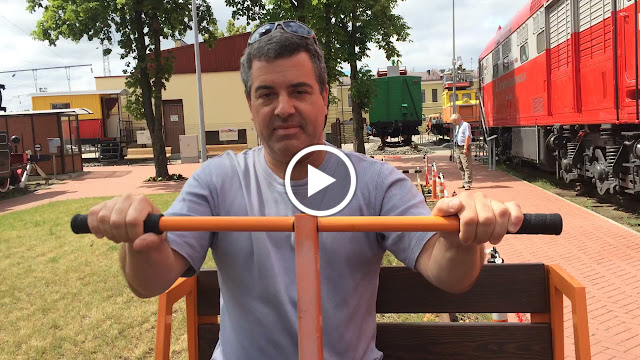
The next day our plan was to spend a half-day in Vilnius, then pick up our rental car at the airport and do a leisurely drive to our next and final destination, the town of Nida on the Curonian Spit. Our car pickup was at the airport, and since the timing of trains to the airport was such that we had 45 minutes to spare, we visited the small but interesting Lithuanian Railway Museum, which uses some maintenance tracks alongside the Vilnius train station. We saw vintage (including Soviet-era) Lithuanian Railways rolling stock and locomotives, and even got to hand-operate one of those track-inspection carts you see in cartoons all the time!


It looked to be about a 4.5 hour drive

Railway museum

The world's shortest airport train

The boring drive to the Curonian Spit

Next: the Curonian Spit and Joninés

Baltics 2016 part 3 - Riga

We had learned from our fellow-travelers in Tallinn that the only train service in the Baltics is local suburban trains from the capitals; international travel between the capitals is by bus. (The one exception is St. Petersburg, to which you can travel by train from Tallinn.)

The buses were all express, joining the Baltic capitals with no intervening stops. This surprised me since, without a rail network, I wondered how people get to the smaller towns and other things between the capitals. (We would later learn that in general, there are no smaller towns or other things between the capitals.)

Miguel Ángel and Roberto had been traveling northward from Lithuania by bus, and assured us that the buses were really comfortable, with free wifi, free coffee, and so on–they made it sound like business-class air travel, and we did spend a little more to book with the company that is supposed to have the more "deluxe" and comfortable coaches.

We were quickly reminded, though, that (a) even the most comfortable bus in the world is still a bus, and (b) these weren't the most comfortable buses in the world. They weren't terrible, but the seats weren't particularly comfy and the wifi never worked. Oh well. They run pretty much on schedule, and we arrived in Riga around dinnertime and checked into our AirBnB hosted by Ed, a very cool hipster type guy and located smack in the middle of Old Riga.
Rihard Wagner gatve, our street in Riga

View into courtyard from our studio apartment
In Tallinn we had shared a table with a reserved young woman who turned out to be a professor visiting from the University of Latvia—she was in Tallinn for a seed biology conference—and we had asked her for recommendations on where to eat in Tallinn. She recommended Ala ("Cave"), a beer cellar dating from the 13th century that is now known for its wide variety of Latvian beers on tap, traditional cuisine, and traditional folk entertainment. The Baltic capitals are small and we always stayed in the old town, so Ala was just a few minutes' walk from our apartment.

Ala turned out to be a highlight of the trip. It was packed mostly with young people, listening to Latvian folk music played by a traditional-instruments ensemble! And the Latvian beers were simply amazing—we had sampler after sampler and must have tried 20 beers in all during our two visits to Ala. The entrées were inexpensive, and the unfortunately named "Grey Peas" was delicious, peas in a smoky gravy served in a hollowed-out dark bread loaf.
Ala interior. The back portion, where the band plays, dates to the 13th c.

The first of 4 samplers

Folk music!

Mmm, grey peas. Tastes much better than it sounds.

The next day we found the Free Walking Tour of Riga, which again was excellent, and led by a guide who looked kind of like David Lehr. The market stalls are four zeppelin hangars that were abandoned by the Germans after WWI, dismantled brick by brick by the Latvians, and reassembled here…

Inside one of the market buildings

Buying smoked pork (a/k/a ham), a Latvian specialty
The tour took us to the "Moscow Quarter" of Riga, where many Russian immigrants lived. The houses there had been made of wood, so that if an enemy approached, the neighborhood could be set ablaze as a deterrent to the enemy entering the city. The story has it that a slightly drunken resident mistakenly raised the alarm in 1812 thinking Napoleon's army was approaching (it wasn't), so the district was proactively burned to the ground for no reason, though a very few of the traditional wood buildings still stand.
Traditional wood-construction building in the "Moscow quarter". The tower in the background is "Stalin's birthday cake"—see below.


Our David Lehr doppelganger tour guide standing in front of the building built to commemorate Stalin's 80th birthday. Apparently other eastern European cities including Warsaw have similar monstrosities. It was to serve as worker's housing of some kind.


Kemeri National Park

For our second day in Latvia, we decided to go out to Kemeri National Park, a forest-and-bog preserve on the coast and about 40 minutes away by commuter train (fare: about 80 cents each way). 
Bike rental was available at the train station…

…but other than the bike rental guy, there's really no one out here.


Lovely wetlands mix with new-growth forest

A couple of nice birdwatching decks overlook the wetlands
We turned in a solid 20 to 25 mile loop ride on roads, fire roads, and mild single-track. Most of the second half of the loop just followed the coastal road, so we took the opportunity to check out the beach, which was quite attractive but not very busy—this part of the country isn't the "beach destination".  That distinction belongs to Jurmala, the "Latvian Riviera", which the train actually passes through on the way to Kemeri. It's the same stretch of beach, but there is a town with Swiss/European pretentions, which reminded me a little of Montreux, Switzerland. Apparently this is where wealthy Russians would vacation and/or build big beach mansions. We skipped it, though plenty of families were getting on and off the train there.
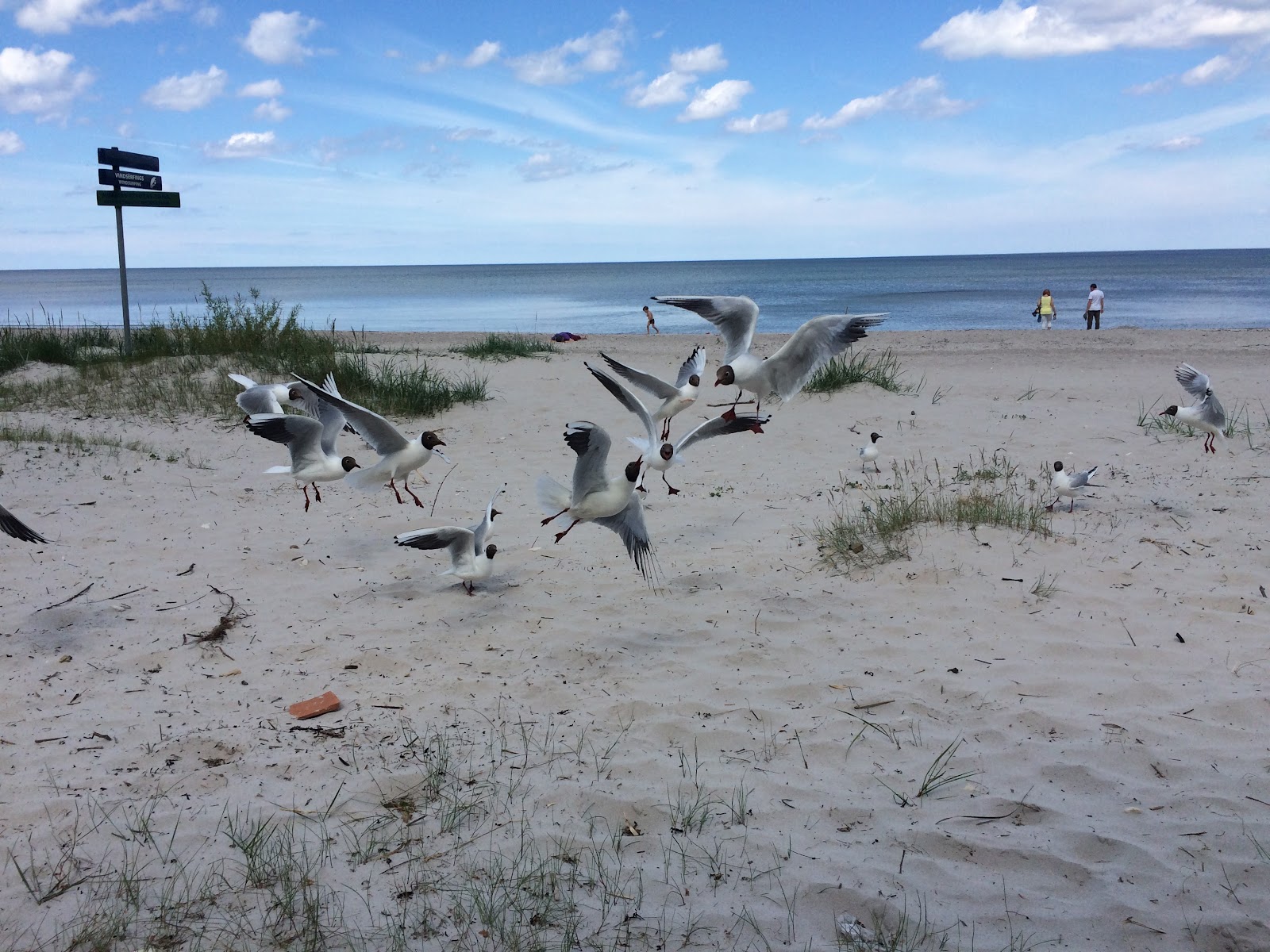
The gulls got the fatty parts of our smoked pork. This beach is a few miles west of Jurmala.

Awful-smelling sulfurated carbonated water emanates from this natural spring adorned by a lizard head. Tonia drank a bunch; I found it retch-inducing.


On the bus to Vilnius, we finally tried Black Balsam, the traditional Latvian digestive. Interesting taste, but it didn't make the threshold for bringing home a bottle.

Lithuania as seen from a bus. There really isn't anything urbanized in between the major cities.


Next: Vilnius