Saturday, June 07, 2014

Village tour!

Today Penguin and I went on a tour of a "rural" village about 90km north of Mumbai.  I use the scare quotes because the village is only about 10km outside a sizable and bustling town (really a small exurb of Mumbai) with modern buildings; apparently the urban frontier is continually encroaching on agricultural land, and this exurb was agricultural ten years ago.

Essentially, the tour consisted of visiting two or three farming families, and a bit of walking in the actual country.  As in many small European towns, farmers consume some of their own produce (rice, cucumbers, root vegetables…) and trade the rest.  These particular farm families are fairly prosperous.  I got to sit in their houses briefly, but as my TripAdvisor review notes, there wasn't really any interaction, for which I ding the tour company mightily.


Penguin and I got to travel on one of those wooden carts pulled by bulls.  I asked why they didn't put tires on them—the wheels are wooden spoked with iron rims, as they have been since the 1800s.  The nominal answer is that these carts are used to haul wood out of the forest along trails where rubber tires would sink; but I think the real reason is that they also preserve a tradition.


The scenery is quite pretty; there are mountains all around, some of which are still active hill stations (holiday retreats) built by the Brits, and one of which has a fort at the top that was built by Chhatrapati Shivaji.  (You did read about him in the previous post about Mumbai, right?)  People do sometimes hike up there, but the trail is supposed to be treacherous, and I can't imagine hiking in this heat.  (In the cool season it gets as cool as 77 degrees...still too hot for me.)


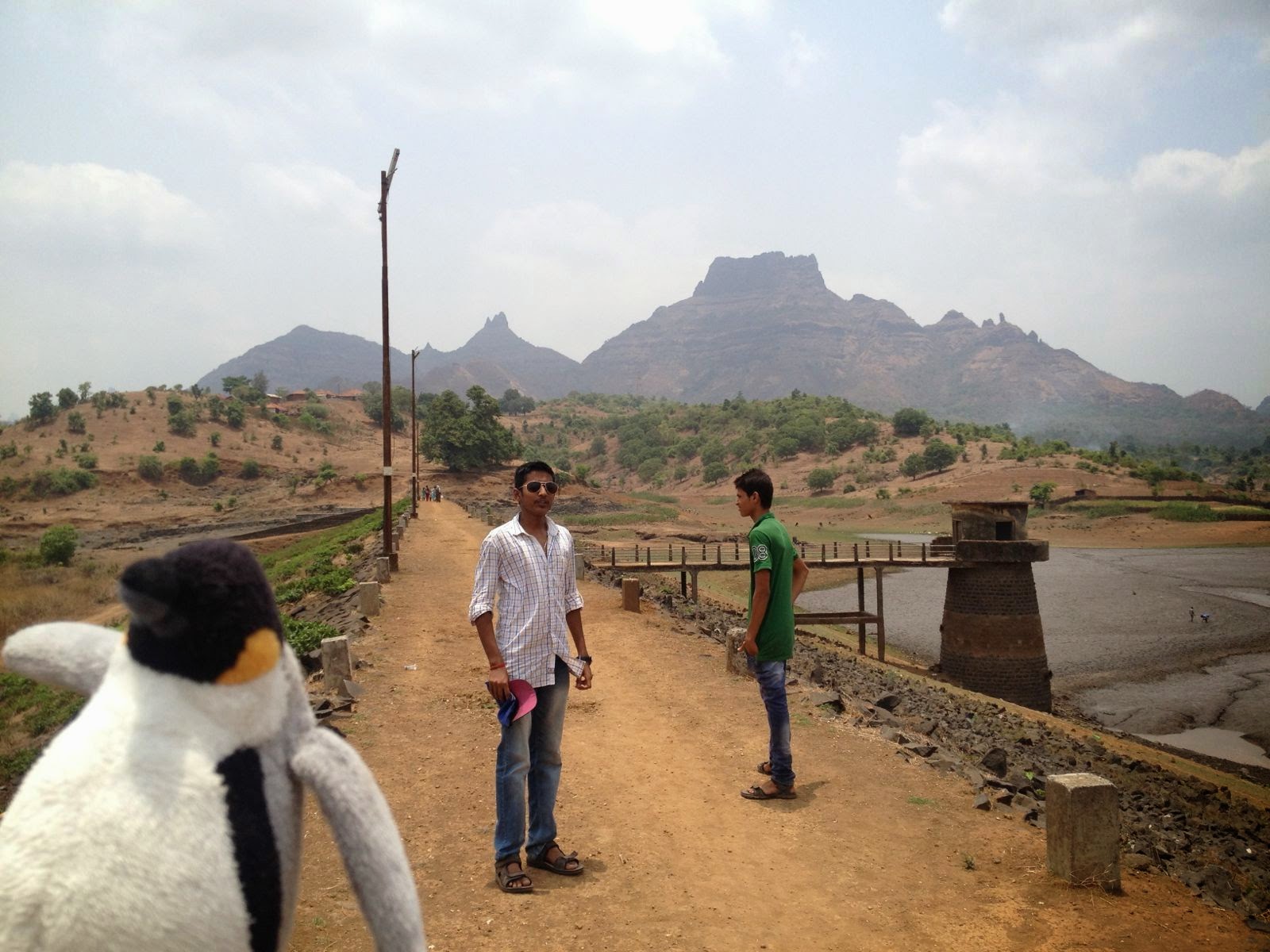
We also walked out over a dam—the lake and river are currently mostly dry, but will fill when the monsoon comes, and all the stuff around it will turn green and grow things.  It's a popular picnic spot because of the surrounding view.


We ended the tour at a sort of outdoor informal restaurant for locals. Think "comedor" in Ecuador: one or two dishes are available, it's home cooked by whoever runs the place.  We had some chole chana (fried chickpeas with garlic and onions) and a tasty chicken curry, and of course Kingfisher beer.  This is my driver, Dupesh, who also works as a piano tuner (!) and with whom I had a great conversation on the ride up from Mumbai, one of the only auto rides I would describe as truly harrowing.  Drivers here have great operating skills and reflexes—I haven't seen one accident—but traveling on expressways here isn't for the faint of heart.  (My guide isn't in the photo, Vishal, but he wasn't very useful.  He didn't say much and it's not clear what value he added.)

Although I could've gotten a ride back with Dupesh, I asked if they could just drop me off at a nearby train station, so I could experience the Mumbai commuter trains.  They tried to sit me in a window seat, but I spent the whole trip hanging out the open doorway like the locals (or like cable car passengers in SF).


Although my official slum tour is tomorrow, we definitely passed through slums on the hour-long train ride back to CST...


The amount of trash here beggars the imagination.  Every urban waterway is toxic and choked beyond hope. Trash mounds are the defining topographic feature along the train lines...

...  And yet I have not seen a single garbage can.  I asked one of my Mumbai guides why not, and he said the government tried to install them, but people would steal them and sell them as scrap metal.  Indeed, people have been known to steal entire bus stop shelters bolted to the ground to sell as scrap metal.  Also, there is a "just throw it on the ground" culture to disposing of trash here, so maybe people wouldn't use garbage cans even if they were provided.  The garbage and sanitation problem here is huge, and it's hard for a westerner to understand what is so hard about instituting waste collection.  Surely it would be preferable for all of this stuff to be put in a number of landfills rather than strewn everywhere, notwithstanding the "garbage pickers" who make a living by picking out recyclables and other items of marginal value, the endless numbers of corvids, and the nontrivial number of goats who pick through the mounds.

Tomorrow is the bike tour and Dharavi slum tour, and my last day in Mumbai.  It's been great visiting here, but I'm ready to be heading home by then.  Mumbai is fascinating, but it is loud, you need two showers a day to really feel clean (especially in this heat), and every place smells like something (they're not necessarily all bad smells, but with this population density and sanitation problems, there is a  lower bound on how much things smell).  My guess is visiting in cool season would be much easier on the senses!


Friday, June 06, 2014

Mumbai day 1: slumdog millionaire

After our morning arrival in Mumbai, it was just a few blocks to the hotel, although it took a bit of orienteering to figure out in which direction.  Mumbai felt cooler than Hyderbad: here it feels like a day that's too hot for Miami, whereas Hyderabad felt like a day that was too hot for Mercury.  But it's deceptive: Mumbai is much more humid, so the effective heat is actually worse.

Victoria Terminus/Chhatrapathi Shivaji Terminus at night

What distinguishes Mumbai's look from Hyderabad's is the presence of colonial buildings left over from the Brits, not least of which is Victoria Terminus, the railway station at which we arrived and the national headquarters of Indian Railways.  Here's a quick panorama of the waiting room, and a  nighttime picture:

In any event, as soon as we checked in and freshened up, it's out for a stroll.  Mumbai is about as hectic as Hyderabad, but it has more of a New York vibe.  In Hyderabad the locals wanted photos with us Westerners; in Mumbai no one gives me a second look.  You can navigate the sidewalk crowds by focusing on a point ten feet ahead of you, just as in Manhattan.  Everyone is going somewhere or doing something; no one is just sitting around.  It's pretty cool.  But hot.

Emboldened by five days in a row of no stomach problems, probably due in part to good judgment and lots of Pepto-Bismol tabs, I had some street food on the way--the kinds of things that would be appetizers in an Indian restaurant, like samosas and fried dough things.


In the nineties, when Bombay was officially renamed Mumbai, many colonial-area names were scrapped in favor of local ones, and "VT" was renamed Chhatrapati Shivaji Terminus (yes, the double "h" is correct) or CST, in honor of a 17th century Maratha king who is seen as a sort of proto-nationalist and in whose name many people committed controversial acts of nationalist violence, kind of like Jesus.

Our 2km walk to the harbor passed a number of these buildings, including Churchgate, the other major rail station....


...before ending up at the Gateway of India, erected by the Brits in 1911 in honor of Queen Victoria's landing there.

It is so hot here that my shirt was absolutely soaked through after a two-hour walk, so I had to come back to the hotel to change and rest up a bit before the Mumbai at Night tour I'd booked. As it turned out, I was the only one who had booked—in fact, I had seen exactly two other Westerners in Mumbai since arriving here.  So I had a lot of opportunities to chat with Manu, my guide, who is working full-time as a guide while also training to be a hair stylist.  He could only afford eight years of formal education—his parents worked for a patroness who subsidized his tuition at a private school, which accounts in part for his good English, since the public schools generally instruct in the local language or Hindi and have minimal English coverage—and he's determined to get fulltime work with his certification and stay financially independent.

He took me to some really cool places, including Chowpatty Beach (actually Girgaum Chowpatty, since the Hindi word "chowpatty" actually just means "beach"), where people come to sit on the sand and eat snacks and enjoy the sunset—but not to swim, as the water is absolutely toxic with raw sewage.  And also with millions of Ganesh statues: during the festival whose name I forget that honors the god Ganesh, people keep small plaster statuettes of Ganesh in their houses for several days, and then ritually sink them in the water at the end.  Given there are something like 10 million Mumbaikars, the bottom of Chowpatty Beach must be several inches deep in plaster Ganeshes.

This is supposed to be the spot to eat the street treat bhel puri, which is puffed rice tossed with fresh raw onions, cilantro, and other potential gastrointestinal disasters.  It was delicious and I've had no problems.


After a visit to a Hindu temple and a Jain temple, both of which were appropriately peaceful, he took me to Banganga Tank, a reservoir filled by a natural spring.  This reservoir dates from the 12th century; its myth is that the god Ram, on a military mission to Sri Lanka, stopped here desperate with thirst; he asked his brother Lakshman to bring water, and Lakshman shot an arrow (baan) into the ground and water gushed forth, thereby creating a tributary of the sacred Ganges (hence, banganga).  Malabar Hill, the ancient neighborhood where it's located, is one of the few spots in Mumbai where you cannot hear the constant honking of car horns, and full of charming narrow lanes.  One imagines this is what Mumbai was like before the automobile.


...and a final stop at the "Hanging Gardens" overlook on Malabar Hill, from which you can see the so-called Necklace, the curved road along the Mumbai waterfront stretching out behind me.  Chowpatty Beach is approximately over my right shoulder where the unusually bright spot is.


The best was saved for last.  I had mentioned that after the tour was over I wouldn't mind having a beer, and offered to buy one for Manu too.  During the tour I had spoken of how I like to try to do local things and meet local people when traveling; so he asked if I'd like to come back up to where he lived—15 minutes north of the center—and have a beer with him and his friends.  I couldn't refuse, and within 15 minutes we were in the courtyard area of a group of buildings that in any US city would probably be called a slum, more for the amount of trash than actual poverty; and there I was having beers with Manu and his crew—Nitin, Aakash, Rajesh, a couple of others, all of whom were amused when I had Manu explain that I knew not one but several students in the US with each of those names only a couple of these guys spoke English (including his brother).  (I just realized I didn't get a picture with Manu himself; he's taking this photo)


With all these guys being in their early 20s, I asked where the girls were.  Culturally, unless you are raised by semi-westernized wealthy professional parents, girls are kept indoors with their parents while the guys go out.  So men and women basically never interact socially until the courtship of their arranged marriage.  It explains a lot about some Indian students I've known in the US.  

Thursday, June 05, 2014

Penguin and I on the Indian Railways


Penguin and I ultimately decided to take a cab to Nampally railway station. I was going to take the commuter train, but the timing was such that I would've had to burn an hour at the railway station, which normally would be fine but I needed to use the time to do work while I still had Internet access.  

My cab driver was super helpful and pointed out that we were making good enough time that we could stop to get me a take-out dinner to eat on the train, and he took me to the take-out outpost of Paradise, which is supposed to have the best biryani in Hyderabad (which is itself known as the biryani capital of India).  I appreciated this since I would otherwise have left here without having any (the hotel restaurant didn't come highly recommended).

With take-out biryani and Kingfisher beer in hand, we arrived at the railway station. I was the only Westerner in (or anywhere near) the station, and as far as I can tell, I was the only Westerner on the train, and I saw no Westerners at any of the station stops for which I was awake.

The station was busy, but not ridiculously so (by the standards of, say, Grand Central, though this small station was much more modest); the most impressive thing was actually how long the platform was. (Sorry for the blurry picture, I was trying to stay out of people's way)

These trains are about 15-20 cars long -- nearly twice as long as long-distance US trains -- and the platform is easily  a quarter mile end-to-end.  All but three or four of those 20 cars were "sleeper class", which misleadingly means "unreserved": you get a ticket, but not a reserved berth, so you fight/negotiate for sleeping/seating space once on board.  

I was in 2nd AC (air conditioned), which is reserved seating, and arranged like this:

(w is a window; > is a seat and points the way you're facing when you sit; vertical lines are bench seats)

 ---  w  -----  w  ------  w  -----
    >   <     >   <     >   <  
   (aisle)   (aisle)    (aisle)   ....  (bathrooms)  
    |   |     |   |     |   |   
    |   |     |   |     |   |   
 ---  w  -----  w  ------  w  -----

    --->  travel direction --->

Here's a short video tour of our seating area.


On the single-seats side (upper row), where I was sitting, there is a cot overhanging the two facing seats; at night, the seat backs fold down so the two seats become a lower cot, and the two passengers who had been facing each other take the upper and lower cots, which are parallel to the direction of travel.  On the bench-seat side of the train, there is a cot overhanging each bench, so the benches and cots are perpendicular to the direction of travel; the benches become cots at night.  Curtains you can draw provide some privacy from the aisle.  Before the train left the station, an attendant came around and placed a pillow, a blanket, and a paper-wrapped package of freshly-laundered sheets on each cot.

Unlike Amtrak, you do the seat-to-bed conversion yourself and negotiate with your seatmate as to when the seats fold up and down.  Our seatmate goes by Reddy (I can't pronounce his first name)...


  It is a little bit tricky to maneuver things in and out of your carry-on if you haven't staged the stuff you need for the ride--we mostly had--but once you're settled, it's cozy but not at all uncomfortable.  The only comfort issue is that the straight-backed seats do not recline, though that seems to be the same in all classes, even in 1st class AC; some trains (not mine) have "executive chair cars" which resemble what we are used to on American trains, with big reclining seats.  Also, if passengers on the opposite side of the train from you choose to keep their curtain drawn during the day, you cannot see out of both sides of the train and the interior can be somewhat dark.

Everyone knows Americans are loud, but Indians are REALLY LOUD!!!  AND THEY TALK FAST!!!!!  AND CONSTANTLY!!!!!!!!!!!  Here is an approximate transliteration of the first few seconds of what I heard from the group across the aisle: 

"inainariladeghoruraigatolentibibuchonintaimavaigedhamairadhoghuvemupedheduvaireghipamanevanintichuchuntutaivunedhachinopupogodhaivaivaigainuvaibaigainteborevanaimogholontoghantudugholontairupameghevedhilenarichovupavivalilorumepudabontupabaemaivubapaipechebogighivaraintubilabitaibadubaigutebeghuvevaichaidaidhoghaimobatainirighobaitodhabumuduntinopudhidhedhudhotavedhitorairodepabaitighomadontiloladhachughugavaimaichalorogilaitagomiraitedagaivadhibeghuntaghivodivachaighentamadinteghev!!!"

I was concerned it would be impossible to sleep, but after the first few stops the lights were turned out and people quited down.  THe earplugs, blindfold and Benadryl definitely helped.  (And during the day, so did my blessed Bose noise-cancelling headphones.)

The equipment is sturdy and aging -- the machinery is vintage 1950's -- but gives the impression of being in good repair.  I walked part of the train and tried to discreetly capture some footage without being rude.  This train has a 1st AC coach (cabins with doors rather than curtains; the cabins and berths are larger than 2AC, but there are four per cabin), 3rd AC (like 2nd, but stacked three-high instead of double-high), and Sleeper (like 3AC, but packed closer together and unreserved, so you have to jockey for seats).  I was unable to move from the 3AC car into the Sleeper cars because they were *packed* with people - walking through one would be like walking through a New York subway car at rush hour, with people sitting in the aisles and car vestibules as well as occupying every square foot of bench/cot space.  Each car has both an Indian-style squat toilet and a Western-style toilet (though both have signs with the ominous admonition "Do not use while at station", which gives you a clue as to where the toilet contents go when you flush).  Nowhere did I see filth or anything disgusting; it is certainly crowded, but everything was sanitary.  There were no chickens on board or anything like that.  In fact, when I opened my beer, the conductor quickly admonished me that beer is not allowed on the train, so I had to ditch it, which was disappointing since it would have gone well with the biryani.

It took a little shuffling things around for penguin and I to get ready for bed, but once we did, it was fine.  The only issue (which I also experience backpacking) is that the padding on the cots is pretty spare, so it's about like sleeping on a Thermarest, which makes me a bit sore; but overall I woke rested at about 6:30am.

Once morning came, Reddy and I folded the seats down and proceeded to have a long conversation.  He works in business contracts, so I assume he's representative of a typical middle class Indian working guy.  He was curious about my iPhone, and with that wonderfully compressed sense of personal space that so many Indians have, he proceeded to look at every photo and ask me questions about it: where is that?  who is that?  what's going on in this photo?  But it was all more like the charm of a curious child than nosiness.  He wanted to know about life in the US as narrated through my pictures.  Do people take the train there?  (He was astounded to learn that it takes 3 days to get from New York to California by train, since no two points in India are that far apart.)  How many states are there?  Is Texas a country?  (It was tough to answer truthfully.)  When people vote in elections, what symbol goes with each candidate on the ballot?  (It took me awhile to figure that out. Because of the high illiteracy in India, each candidate is associated with a pictorial icon, which also appears on the ballot.)  How long was your flight?  Why don't you have children?  Do you live with your parents?  (In India, as in much of Asia, the presumption is that children will take care of their parents when they get old, usually by moving back in with them or living very close by.)  

The other great thing that happened once morning came is the food vendors.  Most overnight trains here don't have kitchens or dining cars: instead, individual food vendors get on and off at different stations and roam the train selling bottled water, packaged snacks, masala chai, chai coffee (I had four little cups, just 10 rupees each, which is about 15 cents), baked goods (I had a couple of fried dough things stuffed with chickpeas), "bread omelets" (basically an omelet sandwich), and more.  There's some remote possibility that the food had been reheated rather than recently cooked, but there is so much turnover that I doubt it.

In short, the trains work.  There is no luxury or glamour on board (or beer), and it's not particularly fast, but every available seat is filled: there is a waitlist system in which, at the second station of a long-distance train, a waitlist of people (who have pre-reserved a spot on the waitlist!) are given seats that were reserved for no-shows who didn't board at the origin station.  (There is no "standby list" in the airline sense; the pre-reserved waitlist can rarely be fully accommodated.)  People behave very chill (for Indians, loudly talking in a continuous stream of short syllables is chill) and, modulo no beer, you don't go hungry during the ride.  The onboard equipment, while dated, seems to work; in fact the railway is the only thing I've seen so far that isn't an unmitigated infrastructural disaster.

...and just like that, we're on the far outskirts of Mumbai, and the mountains of garbage perhaps concealing a haunting Malthusian reminder that maybe India just cannot handle the sanitation needs of this many people (18% of the world's population in less than 3% of the world's land area).  Every kind of construction props up "informal dwellings" - cinderblock walls and corrugated metal roof is at the high end, bamboo framing with palm leaves or cardboard boxes for walls at the low end. 

Now passing through residential developments -- lots of dense high-rises, as on the outskirts of Hong Kong, with more under construction.  We're speeding through train stations where people are boarding overflowing commuter trains.  Those trains travel at full speed with all doors open and people hanging out of the doors.  (Note to self: I want to try that.) Two Western-dressed Asian girls with roll-aboard suitcases - maybe college age - are standing on the platform; they're the first non-Indians I've seen since boarding in Hyderabad, and they look like nonlocals because the other people waiting for the train are sleeping or sitting on blankets, whereas these two are standing up, looking around, one hand on suitcase.

After hotel check-in, it'll be time to do a little exploratory walk of south Mumbai, the area where most of the colonial construction and development occurred!


Hyderabad heritage walk

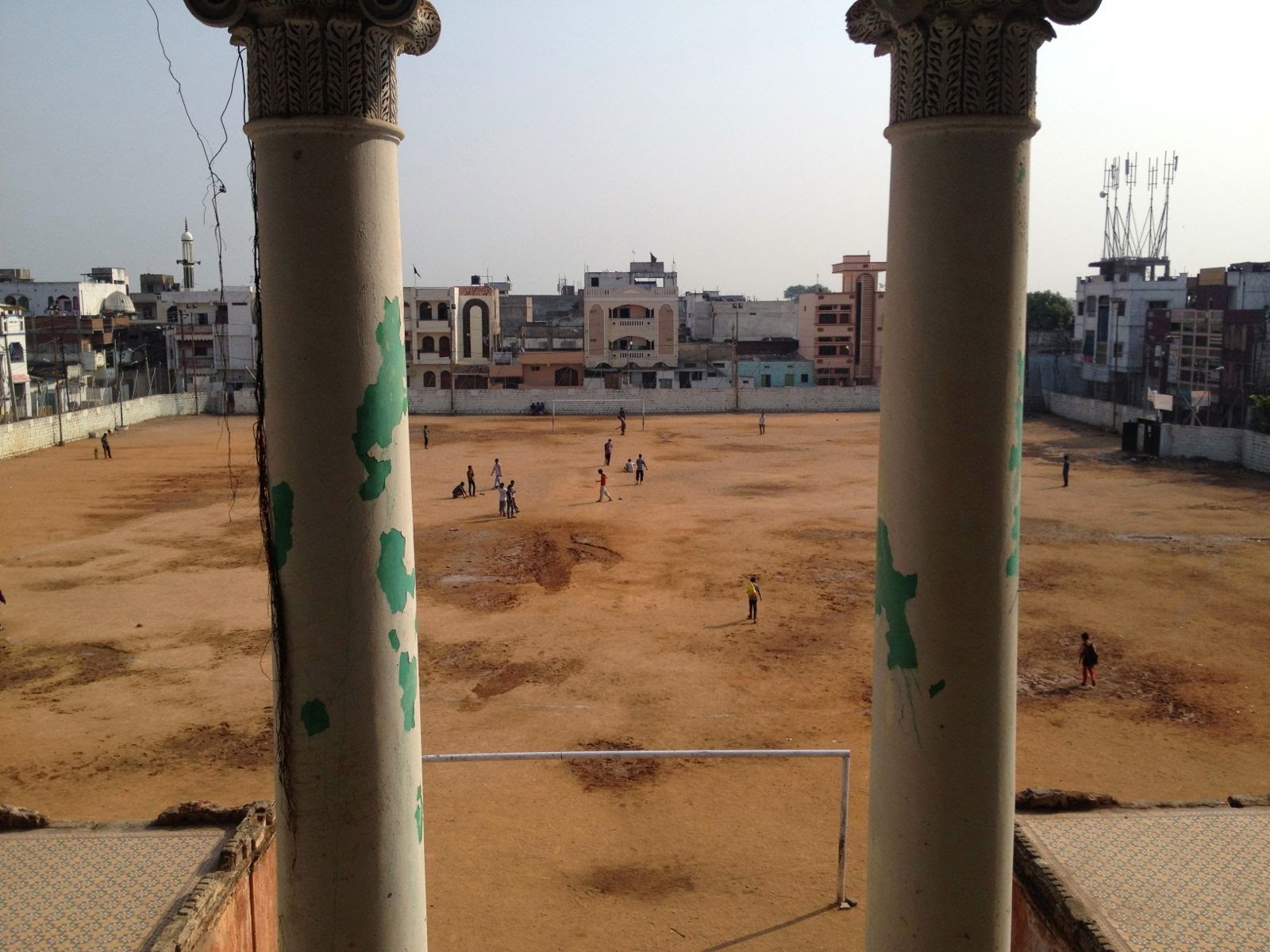
Our last tourist activity in Hyderabad was the most interesting: we visited what used to be the mansions built by the white-collar administrators of the Nizams, those wealthy Persians.  These well-paid administrators aspired to the bourgeoisie as much as the employer they served, and they built mansions to prove it.  Most were European-wannabe architecture, which was all the rage in the 17-18th century here, with courtyards.  Originally the mansions stood on large tracts; in time the city filled in around them.

Now the mansions are in irreversible disrepair, and many people squat there.  Basically, if a structure here has at least two walls and can be roofed, someone will be living there.  Not sure I'd go so far as "squalor", but certainly "extreme austerity" -- more than the most unpretentious and modest conditions we ever see in Mexico.  One of the mansions dedicates one floor to a family and the other floor to goats; the result smells about the way you'd expect.   I couldn't figure out where the family did their toilet, and I don't really want to know; I can't believe this place would have running water.


While it's depressing that no one has stepped up to rescue these structures or at least declare them off-limits to squatters, this was the most interesting of the Hyderabad tours since it addressed an important facet of the history and got us into backstreets of the Charminar area where tourists definitely never go.  It is worth remembering that more than half the world's people live this way (if not even more austere). Worth remembering next time you hear someone use the expression "That's a first world problem".

Oh, right - my two presentations were successful by any standard, and there were even a handful of Indian students who recognized me from taking the MOOC.  They were honored to meet me in person and wanted a picture with me, and were positively giddy when I offered them free book copies.  It is nice to feel one is making a difference; the whole purpose of my trip was to help Indian faculty adopt our stuff, and I think based on the reception I received that it's been a successful trip.


Next: Penguin and I travel to Mumbai in 2nd class rail, with the working people!

Chowmahalla Palace and Charminar (old city)


Imagine you need to get from the East Village to West 125th Street.  It is rush hour on a Friday afternoon going into a holiday weekend.  Because of a power outage, there are no traffic lights.  Because of a manpower shortage, there are no traffic cops available to direct traffic.  There is no subway.  The buses have no special lanes.  In fact, the lane divider lines have been mysteriously erased from all the streets, even five-lane streets like Second Avenue.  For every car, there are numerous scooters or mopeds.  A very few people are not in motor vehicles, but on camels. (Yes! camels!) Pedestrians are blind and deaf and cross streets and freeways heedlessly.  This is what it is like to drive anywhere in Hyderabad, at any time.

Actually, it's worse, because the main "right of way" rule seems to be: The hell with you, I'm coming through.  Even in LA, these drivers would each be considered insufferable jerks, but since everyone behaves the same way, they don't consider it rude.  Amazingly, we saw no accidents, though many near-misses.

The result is that getting anywhere is stressful, even if you're not driving, due to frequent short stops, lane swerves, and constant, truly constant, honking.

But I digress.  Today we visited the Charminar, the four-towered monument that is Hyderabad's icon, and Chowmalla palace, both built by the Nizams, the wealthy Persian dynasty that traipsed down here in the 15th century and is responsible for making Hyderabad the only Muslim-dominant area in India.  We got some photos and I shot a bit of video from the observation deck of the Charminar to give you a sense of the baseline level of noise and traffic here.


The palace was OK, but I'm usually not interested in the vintage car collections of old royalty (the tour was designed for midwesterners, I think).  Penguin thinks it's too la-di-da for his taste.  (If you look closely at the duck pond picture, you can see a cormorant diving in the background.)


 I endured it because I was looking forward to the walk back to the bus via the street market.  Although the market itself turned out to be unremarkable (compared, e.g, to Otavalo), it gave me an opportunity to look around and realize what an infrastructural catastrophe is going on here.  Nothing looks finished.  The roads are good, but the sidewalks are usually unpaved.  And no grass or trees - just dust.  In a hot dry climate, this gets kicked up as particulate smog, more so when sweepers try to sweep in front of their shops.  Also, while the roads and paved areas were reasonably clean, dust attracts trash, which attracts more trash, which attracts goats, of which we saw many.  (They are all privately owned, usually for dairy, and the owners let them roam free and eat what they may.)  It seems that paving the sidewalks or planting them with natives would be a low-cost way to control trash and smog.  When buildings are built, the owner cannot always afford to build the whole building, so they build the vertical rebar supports to the maximum planned height of the building and then build the subset of floors they can afford, hoping to come back and add more later.  The result is almost every building, even brand-new modern construction, appears to be sprouting rebar plants from each corner of the roof...


...except for the new Department of Fisheries Headquarters building...


There are as many buildings under construction as there are buildings on which construction appears to have been abandoned; I wondered why they don't finish those buildings before starting new ones.  All the electrical wires are strung on poles aboveground; imagine housing density comparable to the Mission where the electrical cable for each individual apartment or office in a building is strung on wires.  As a result, when it rains hard, blackouts are inevitable; we had a brief one even in my hotel, which is part of the ultramodern convention center built only in the last few years.

The downside of my Hyderabad stay is that everything interesting to see requires a harrowing 45 to 60 minute (each way) car trip, and by the time we get back, the last thing I want to do is get in another car to go to dinner (the conference center is greenfield development in the middle of nowhere, so there is absolutely nothing to walk to; though the upside is it's absolutely quiet at night.)


I'm sure Mumbai will put me closer to India.  Looking forward to that part of the trip once I'm past my presentations!

Sunday, June 01, 2014

Golconda Fort and Qutb Shahi tombs

Hyderabad is unusual in being a Muslim enclave within an overwhelmingly Hindu country.  This is due in part to its history: in the 15th-16th centuries it was invaded by the Persian Sultan Quli Qutb, and the Qutb dynasty ruled the area for 170 years.

The Qutb were great builders, and one of the things they built was this set of 7 tombs for their rulers, perhaps the only known tomb complex housing an entire dynasty in one place.  The setting and structures are run-down, but Iran is collaborating with India (in view of the Persian heritage of the setting) to fix it up.


They also built the Golconda Fort, originally in the late 1500s but it was fortified and enhanced over a period of sixty years.  There is an outer wall around 7km in circumference, but inside the inner wall is where the main fort is.  The Qutb and later Mughal sultans ruled from here, more or less cut off from the common people, until the Persians were kicked out once and for all when the British Raj took over the vestiges of the fading Mughal empire in 1857.


It's a bit tough to get a sense of the scale, but the tallest turrets are about 360 steps from the base where we're standing.  (We got there too late to climb to the top.)  As the sun set, we were treated to a too-long and too-boring sound and light show narrating the history of the fort; the historical parts were good, but they were interspersed with entire poems and songs in Hindi, which is like the first time you read the Lord of the Rings and you were like "I get it.  They like singing.  What happened next?" only it's in Hindi and you can't skip over it.

People in our group were wary of taking photos of the locals, who didn't look unusual except there were a lot of saris (so, like Berkeley) and more than a few burqas.  However the locals had no such wariness of asking if they could have photos taken with us, so I decided to get a copy of one such photo just for fun...


By the time the show was over it was dark, and the fort was beautifully illuminated...


I should mention that we made the 40-minute trip there and back in a pair of microbuses that makes the school-bus-vintage vehicles used in Mexico look state-of-the-art.  Driving is a disaster here; essentially, you honk constantly and fight your way through.  Tonia and I had some experience of this in Chiang Mai; this is much worse and much louder.  Nobody on our bus could figure out the honking algorithm, but we did not go 15 seconds (literally) without honking during the entire trip.  I'm amazed there aren't more accidents (we didn't see one).  Drivers with an entire family piled onto their scooter would try to squeeze between, say, a bus and a dump truck, with the driver's facial expression suggesting that a victory in getting ahead of the bus was much more important than the safety of his children.

Later today I'll visit Char Minar, another impressive structure built by the Qutbs, and around which the old town is arranged. This will be tricky because as of today, India has decided to split the state of Andhra Pradesh (whose capital Hyderabad is) into two states, reflecting the fact that before Andhra Pradesh joined India after independence, it really was best thought of as two ethnically distinct regions.  It's hard to see how this will be beneficial (Scotland, are you listening?), but in any event, today is the official day when the split is effective, and Hyderabad will temporarily be the capital of both regions. All kinds of dignitaries, plus a boatload of people and probably demonstrators, will be downtown to observe the event.


Friday, May 30, 2014

SFO-Dubai-Hyderabad

Penguin and I had generally uneventful flights from SFO to Dubai and thence to Hyderabad.

The flight from SFO to Dubai is the longest single commercial flight segment in existence at 15.5 hours.  The departure lounge looks more western than I expected; a few people of Middle Eastern-looking descent, though many of them displaying US passports; a few saris, so I guess I'm not the only one connecting there to India; and maybe a dozen or so women with headscarves.  (No burqas.)

It was a fine flight even though I was in coach--Emirates' coach section is like Virgin's, and those happy lozenges really work.


Penguin woke up as we were on final approach for DBX.  He thought we were in Dallas, because it's dry, there's lots of sprawl, and the landscape is everywhere bisected by six-lane-each-way freeways with cloverleaf interchanges the size of several city blocks.  You can see completed developments (ranging from bulky homogeneous condos to McMansions) as well as developments whose streets have been traced but no other work done.  They are following the sprawl formula to the letter, except that the cloverleafs are unbelievably enormous--the triumph of the car here is complete (although apparently there's an ultramodern Metro from the airport to the city).

Dubai's ultramodern airport reminds me of SFO terminal 2, except with prayer rooms instead of a yoga room.  Penguin wanted to get a picture in the prayer room but I convinced him it was probably inappropriate.

At 8:40pm, the muezzin chanted prayer time over the airport loudspeakers.  OK, now we're not in Texas anymore.  No one at my gate reacted, but I assume that's because those who would be serious about this were already in the prayer rooms.

(A nice thing about flying to India via the Arabian Peninsula is all the inflight food is really good.  My inflight  meals were a vegetable masala on flight 1 and a vegetable paneer curry on flight 2.  Other alternatives would have been lamb or chicken.)

There was severe weather at Hyderabad airport, with an approach so rough that the pilot pulled up and said we'd be in a holding pattern until the weather moved away from the airport.  In all it took 3 attempts and a 30-minute delay to finally land (smoothly).  The conference organizers had thoughtfully setup a welcome desk at the airport for clueless international travelers; the two student volunteers who had drawn the "night shift" manning that desk woke up bleary-eyed when our 3am flight came in, so it was easy to get a taxi to my hotel.

The conference center and hotel grounds ("Hitec City") are kind of an enclave: you can't really walk anywhere from here.  Also, the interesting part of Hyderabad is the old city, which is pretty far from here.  This evening I have a tour of some part of it, so I'll send pictures from that.

The breakfast buffet is like Hong Kong--very international, including lots of tasty Indian food.  I'd never had coffee accompanied by idli sambar, by little fried dough things with ginger chutney, "crispy bacon" (English style), and so on.  And of course some Raisin Bran for...you know.

Penguin says it's time for a nap (while I work, of course).  Next entry will hopefully have some photos from Hyderabad old town.